


What Are the Best High-Performance RPC Node Providers for Cosmos Networks in 2026?

High-performance RPC node providers offer reliable, low‑latency access to Cosmos blockchains. Free public RPC endpoints often have rate limits, high latency, and no uptime guarantees. For production dApps, validators, and high‑load services, dedicated RPC or self‑hosted nodes are recommended. The leading providers in 2026 include Crouton Digital, Polkachu, Allnodes, NodeStake, and ITRocket. This guide explains how to choose the right provider based on your needs.
What Are the Best RPC Providers for Blockchain Apps for a Public RPC Endpoint?
RPC meaning – Remote Procedure Call – is a protocol that allows applications to communicate with a blockchain node. In Cosmos networks, public RPC endpoints are free gateways used by wallets, dApps, and explorers.
Why Do dApps, Wallets, and Validators Need Reliable RPC?
Without RPC, no application can interact with the blockchain. Here are the main use cases:
- dApps and DeFi protocols – read prices, balances, send transactions.
- Wallets – display balances and transaction history.
- Explorers – fetch block and transaction data.
- Validators – monitor node health, query network status, and support operational tooling.
- Developers – test smart contracts and debug transactions.
Reliable RPC infrastructure directly affects application responsiveness, wallet UX, transaction broadcasting, and the overall stability of blockchain applications.
How Do the Best RPC Node Providers Compare Public vs Dedicated vs Self‑Hosted RPC?
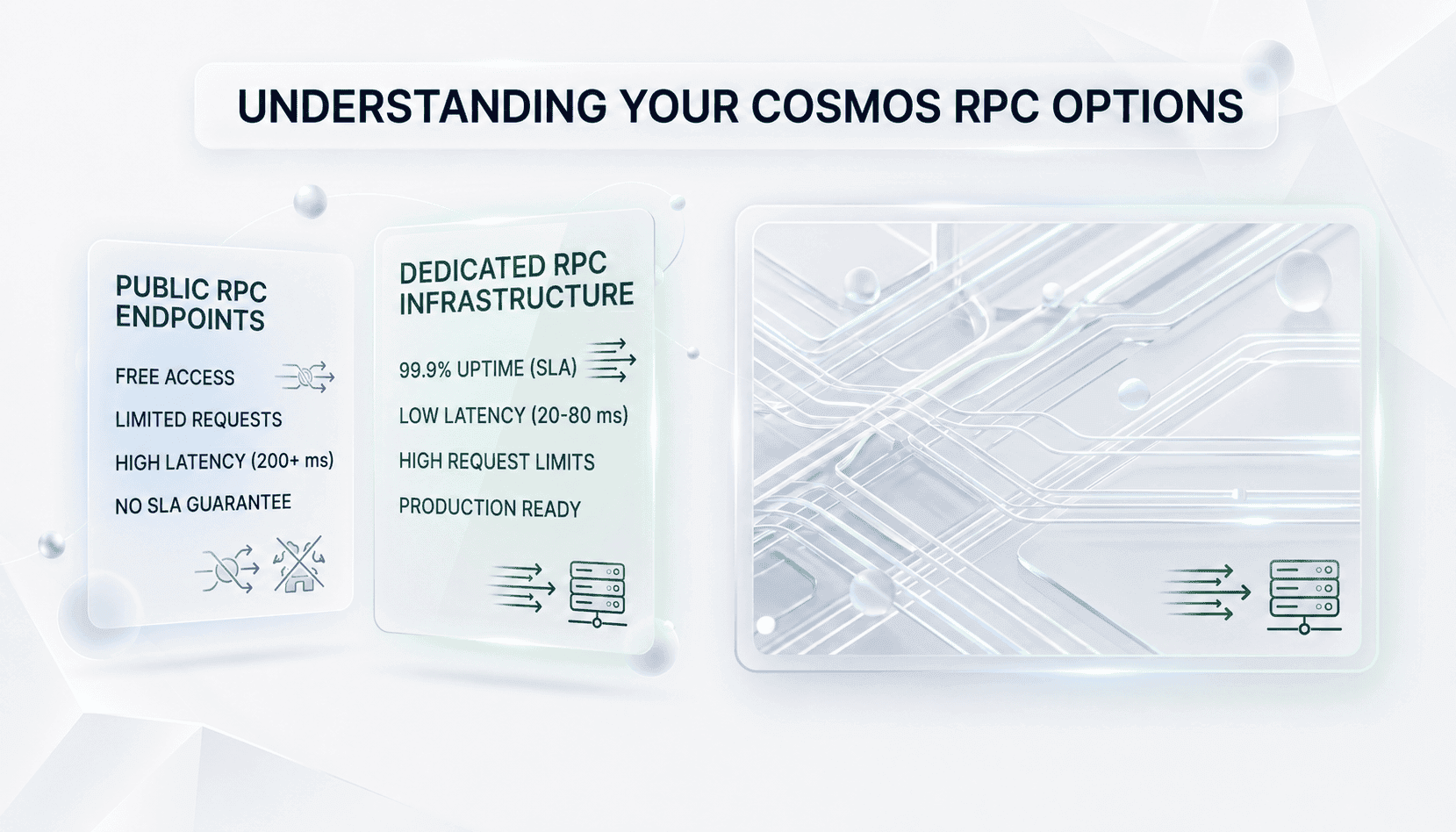
RPC Types Comparison
| Type | Uptime Guarantee | Typical Latency | Rate Limits | Best For |
|---|---|---|---|---|
| Public (free) | No (95–99%) | 200–1000+ ms | Strict (10–50 req/s) | Testing, small scripts |
| Dedicated (paid) | Yes (99.9%+) | 20–80 ms | High / unlimited | Production dApps, DeFi |
| Self‑hosted node | Your responsibility | Minimal | Unlimited | Validators, full control |
These are indicative ranges only. Actual latency, uptime, and request limits vary by provider, region, chain, endpoint type, and plan.
What Are the Main Problems with Free Public RPC Endpoints?
- Overload – shared among thousands of users.
- No SLA – no uptime guarantee; outages are common.
- Rate limiting – heavy usage leads to 429 errors.
- Inconsistent state – different nodes may show different block heights.
Public RPC endpoints are useful for testing and low-volume workloads, but production applications often require dedicated RPC infrastructure to avoid rate limits, unstable latency, and service interruptions.
What Criteria Define Leading Blockchain RPC Node Providers?
When evaluating best rpc providers for blockchain apps, consider these metrics:
Provider Evaluation Criteria
| Criterion | Ideal Benchmark | Why It Matters |
|---|---|---|
| Uptime (30 days) | ≥99.9% | Minimises downtime and missed rewards |
| Latency (global avg) | ≤150 ms | Better user experience |
| Rate limits per IP | ≥200 req/s or negotiable | Prevents throttling under load |
| Multi‑chain coverage | 40+ Cosmos chains | Reduces need for multiple providers |
| Archive nodes | Available | Needed for historical queries |
| WebSocket support | Yes | Required for real‑time subscriptions |
Which Cosmos Networks Should a Provider Support?
A good rpc provider should at least support:
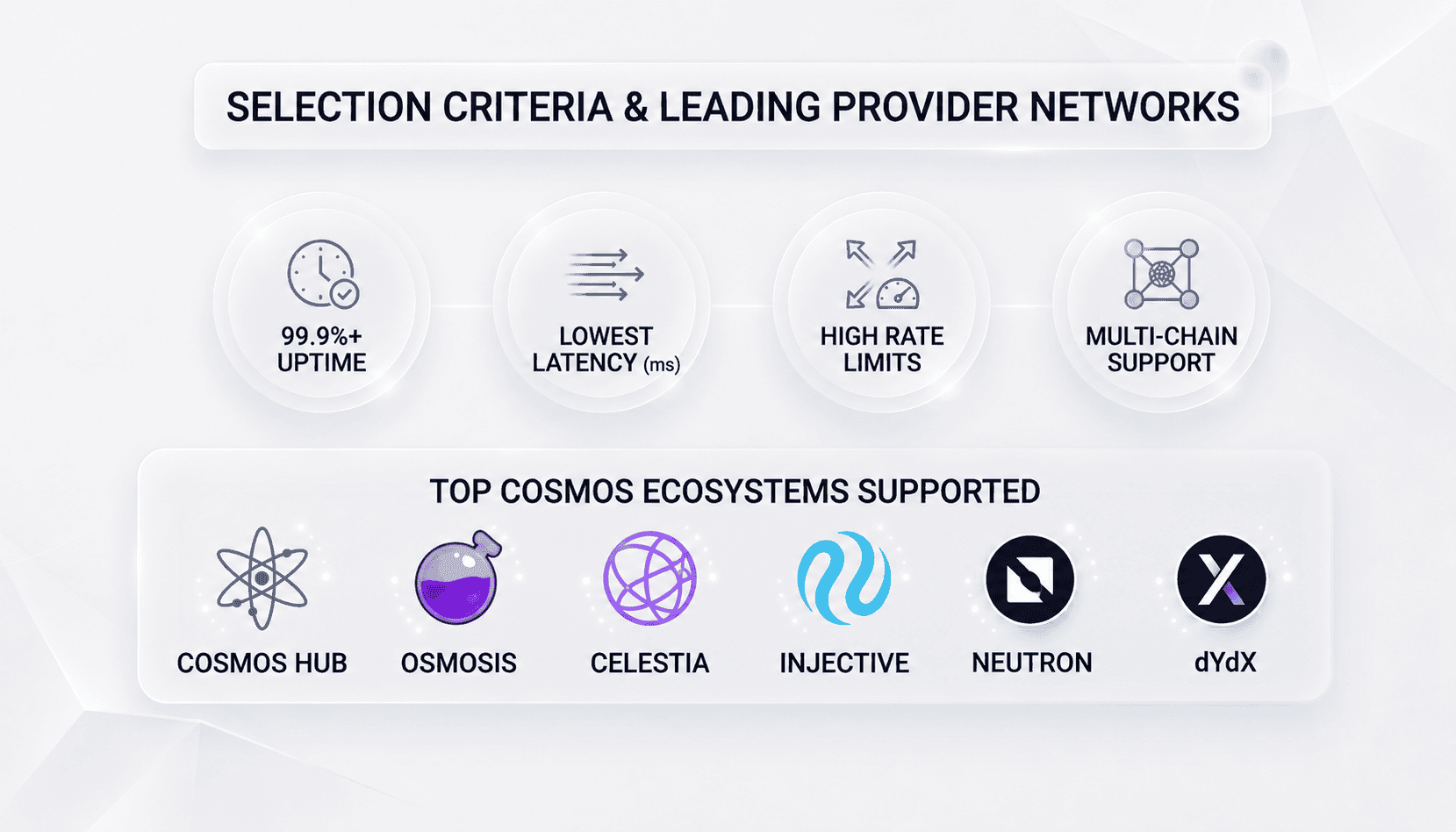
- Cosmos Hub (gaia)
- Osmosis
- Celestia
- Injective
- Neutron
- dYdX
- Akash
The more chains, the better for multi‑chain projects.
Who Are the Leading RPC Node Providers in Blockchain for Cosmos in 2026?
Several infrastructure companies serve the Cosmos ecosystem. The list below is alphabetical and not ranked. Each provider has its own strengths; the choice depends on your specific needs.
Allnodes
Allnodes provides node hosting and staking services, while its PublicNode service offers free public RPC endpoints across many networks. For Cosmos, Allnodes also offers full node hosting; archive or dedicated RPC requirements should be verified per chain and plan.
Crouton Digital
Crouton Digital operates validators across 45+ PoS networks, including Cosmos. It offers public (free) and dedicated (paid) RPC endpoints with archive nodes and WebSocket support. The company is also building Nodelabs, a beta-stage automated node deployment platform. During beta, Nodelabs does not guarantee SLA; uptime and performance targets are expected after General Availability. Separately, Crouton Digital's RPC infrastructure focuses on uptime, monitoring, and enterprise-grade reliability.
ITRocket
ITRocket provides public endpoints for selected Cosmos networks and may also offer higher-performance infrastructure for advanced users. Availability, limits, and commercial terms should be verified per network.
NodeStake
NodeStake provides free public RPC, API, and gRPC endpoints across many networks; practical limits and abuse controls should be verified before production use. NodeStake's dedicated plans are competitively priced, and they have a reputation for helpful community support. They also operate validators, so they understand the needs of both developers and stakers.
Polkachu
Polkachu is a well‑known validator offering free public RPC and affordable dedicated services. Their public endpoints are widely used for testing and small projects due to generous rate limits and good uptime. Polkachu also provides dedicated RPC with higher performance and priority support. Many Cosmos teams start with Polkachu's free tier before upgrading.
Recommended rpc node providers list will vary based on your priorities: cost, performance, or support. Each of the above providers has its niche; evaluate them against your workload, required chains, and budget.
How Does RPC Meaning Help You Choose the Right Cosmos Provider?
Follow these five steps:
- Test public endpoints from multiple providers – measure latency from your region.
- Check uptime history – look for status pages or public dashboards.
- Evaluate rate limits – if you make many requests, you need higher limits.
- Compare dedicated plans – price, SLAs, and additional features (archive, WebSocket).
- Implement fallbacks – never rely on a single provider.
Rpc cosmos endpoints from different providers can be combined for redundancy.
When Should You Use Public, Dedicated, or Self‑Hosted RPC?
| Your situation | Recommended RPC type |
|---|---|
| Testing a smart contract or small script | Public RPC |
| Building a production dApp or DeFi protocol | Dedicated RPC |
| Running a validator | Self‑hosted node |
| High‑frequency trading bot | Dedicated or self‑hosted |
What Makes a Cosmos RPC Provider Like Crouton Digital Reliable?
Crouton Digital is one of several infrastructure providers in the Cosmos ecosystem. The company operates validators in 45+ Proof‑of‑Stake networks and is building Nodelabs, a beta-stage automated node deployment platform. Their RPC offering includes:
- Public (free) endpoints for testing.
- Dedicated RPC with 99.9%+ uptime and SLA.
- Archive nodes for full historical data.
- WebSocket support for real‑time subscriptions.
Crouton Digital is suitable for teams that need enterprise‑grade infrastructure, but other providers also offer quality services.
Summary – How to Choose a Reliable RPC/API Provider for Your Needs
- For testing and development: use free public endpoints (Polkachu, NodeStake, Crouton Digital free tier).
- For production dApps and DeFi: invest in dedicated RPC (Crouton Digital, ITRocket, Polkachu paid).
- For validators: run self‑hosted nodes or use hosting services (Allnodes, Crouton Digital).
- Always use fallbacks – configure at least two endpoints to switch automatically.
Popular rpc node providers offer both public and dedicated options. Evaluate based on your priorities: cost, performance, or support.
Conclusion
Choosing the right RPC infrastructure for Cosmos networks requires balancing cost, reliability, and control. Public endpoints are fine for development, but production applications benefit from dedicated solutions or self‑hosted nodes. Providers such as Crouton Digital, Polkachu, Allnodes, NodeStake, and ITRocket each offer valuable services. Evaluate them against your specific needs, test performance, and always plan for redundancy.
About the Author
This article was prepared by the Crouton Digital Research Team — Web3 infrastructure specialists focused on RPC/API infrastructure, validator operations, and proof-of-stake network ecosystems.
Hands-on experience includes:
- Cosmos RPC/API infrastructure and node operations
- multi-chain PoS network monitoring and performance analysis
- evaluation of public, dedicated, and self-hosted blockchain infrastructure providers
Editorial Standards & Transparency Notice
Crouton Digital follows research principles based on publicly available data, observable infrastructure features, and provider performance indicators. Provider comparisons prioritize reliability, uptime, latency, transparency, and infrastructure readiness over marketing claims.
Crouton Digital is included as one of the evaluated providers and assessed using the same criteria applied to others. This content is for informational purposes only and does not constitute financial, investment, or technical advice. Always conduct your own research and verify provider limits, performance, and terms before choosing an RPC/API infrastructure partner.
Frequently Asked Questions

A Web3 OG who has navigated the industry’s evolution from whitepapers to widespread adoption. Having built through the euphoria of bull runs and the discipline of bear winters. Opinions are strictly personal, crafted from years of deep-dive research and hands-on experience in the trenches.