


What Are the Top Fast-Sync Snapshot Providers for Cosmos SDK Networks in 2026?

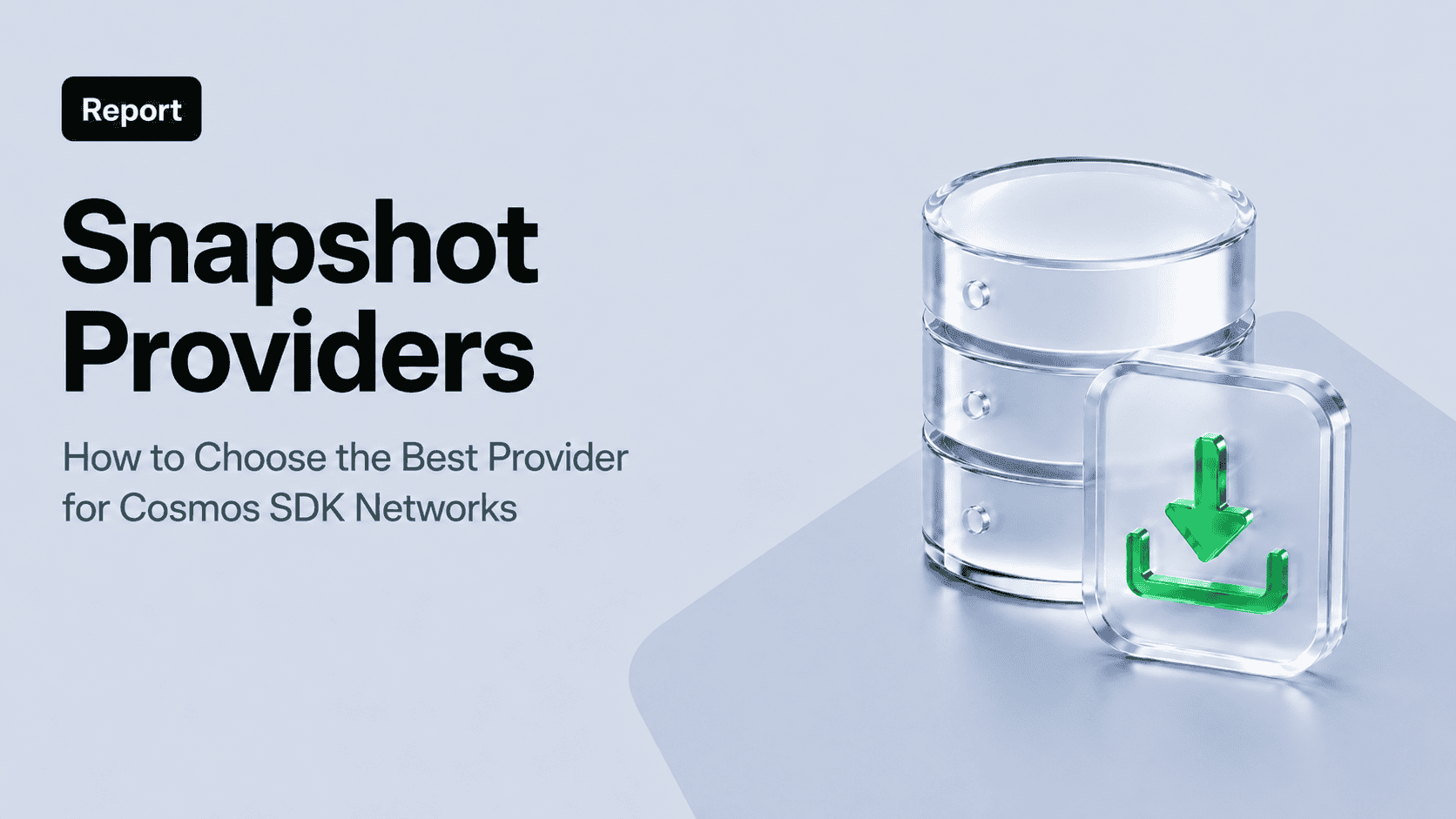
A fast-sync snapshot is a compressed backup of a node's database. Instead of syncing from genesis for days or weeks, you download, extract, and start your node in 30 minutes to several hours — depending on snapshot size and hardware. Snapshots are essential for validators, RPC providers, explorers, and infrastructure teams to spin up nodes quickly, recover from crashes, or scale. Community providers like Polkachu and Quicksync offer free public snapshots. Commercial providers like Crouton Digital, Lavender.Five, and NodesHub deliver enterprise‑grade solutions with SLAs, regular updates, integrity checks, and dedicated support. Choose based on your use case — validators typically need pruned snapshots (fast, small), while archive nodes and indexers require full historical data.
What Are Fast-Sync Snapshots for Cosmos SDK Networks?
A blockchain snapshot is a point-in-time copy of a blockchain node's database that captures the entire blockchain state up to a specific block height. Instead of replaying every transaction from genesis — which can take days or even weeks — you download a compressed snapshot, extract it, and start your node from that state. This approach is especially valuable for any cosmos network, where joining the network quickly is essential for validators and infrastructure teams.
The Cosmos SDK provides built-in support for snapshots and state sync. Nodes can take snapshots at regular height intervals and store them as binary files. These snapshots can then be used by other nodes to bootstrap quickly.
Snapshot Restore vs State Sync vs Full Sync from Genesis
| Sync Method | Speed | How It Works | Best For |
|---|---|---|---|
| Full sync from genesis | Days to weeks | Replays every block from the beginning | Archive nodes, full historical data |
| State sync (CometBFT) | Hours | Pulls a snapshot via P2P from trusted peers | Validators, quick node spin-up |
| Snapshot restore (manual or automated) | 30 min – several hours | Download compressed archive from a provider | Node recovery, migration, RPC scaling |
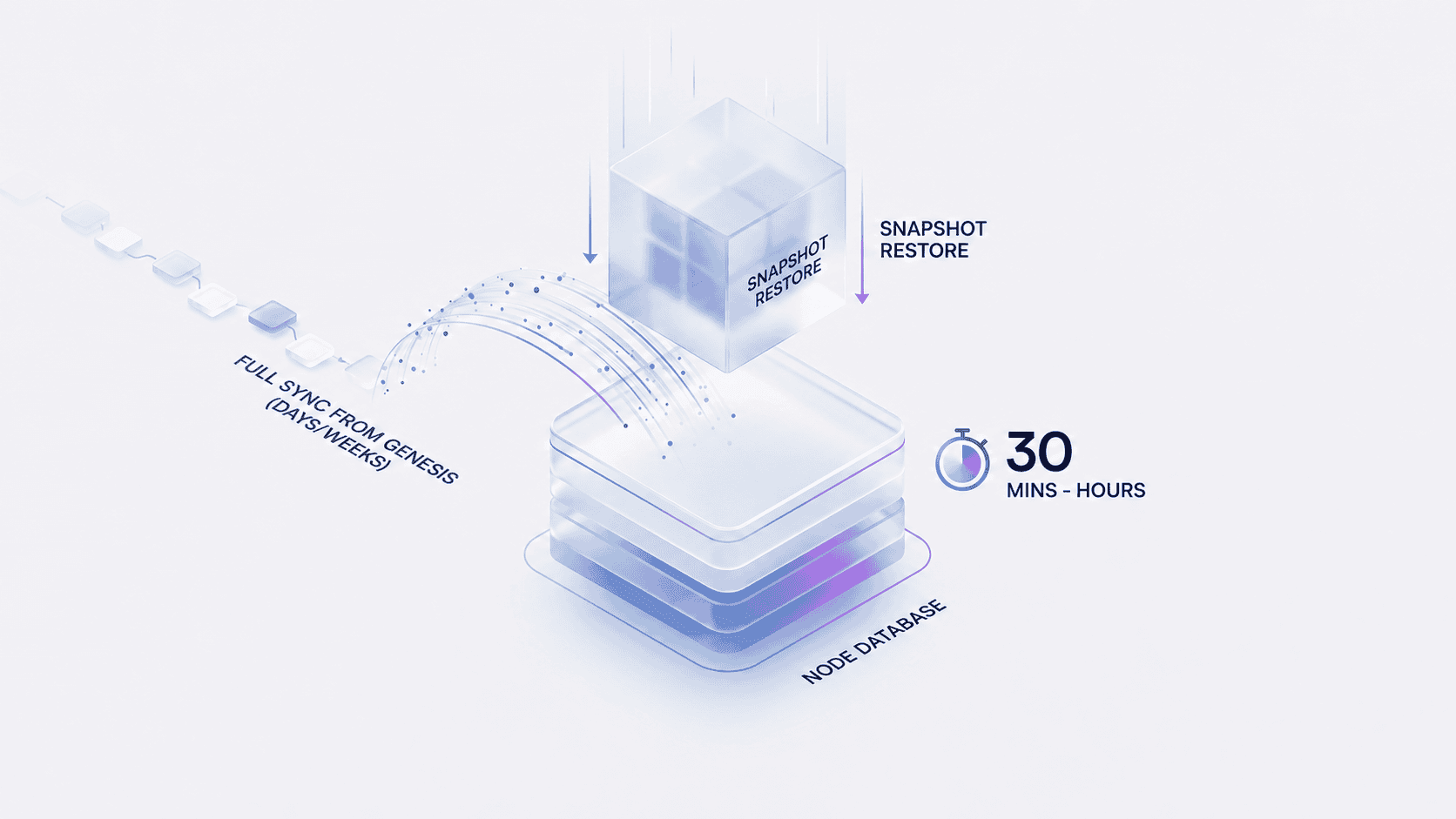
"State sync allows new nodes to bootstrap from a snapshot rather than replaying all historical blocks." — Cosmos SDK documentation
Why Do Validators, Node Operators, and RPC Providers Use Snapshots?
RPC provider use snapshots to deploy additional endpoints quickly, ensuring they can scale to meet demand without waiting for full syncs. Common use cases include validator setup, node recovery after crash, RPC scaling, node migration, test environments, and explorer and indexer deployment.
"Snapshot restore is the fastest practical recovery — download + extract can take 30 minutes to 3 hours depending on snapshot size and your connection."
What Data Does a Typical Snapshot Contain?
A Cosmos SDK snapshot typically includes:
- Blockchain state — Current state of all accounts and balances
- Application state — Data specific to the chain's modules (e.g., staking, governance, IBC)
- Node database — The actual database files (e.g., LevelDB, RocksDB)
- Pruning data — Depending on the provider, snapshots may be pruned (recent history only) or full (archive)
For those following a staking guide for cosmos network, snapshots are often the recommended way to get a validator node running without waiting days for a full sync.
Which Cosmos SDK Networks Need Snapshots?
Almost every major Cosmos SDK network has snapshot providers. Key networks include Cosmos Hub, Osmosis, Celestia, Injective, Akash, Neutron, Stride, dYdX, Juno, and Secret Network. Most providers support multiple networks. For example, Polkachu offers Tendermint-based chain snapshots for node operators across the Cosmos ecosystem.
Snapshot Providers — Types and Examples
| Provider Type | Examples | Uptime Guarantee | Update Frequency | Integrity Checks | Support |
|---|---|---|---|---|---|
| Community / Public | Polkachu, Quicksync | None (best effort) | Daily to weekly | Basic (checksums may be provided) | Community forums |
| Commercial / Enterprise | Crouton Digital, Lavender.Five, NodesHub | SLA-backed (99.9%+) | Regular (hours to daily) | Full checksums, verification tools | Dedicated support |

NodesHub and Lavender.Five are infrastructure companies that provide both public snapshots and paid enterprise services with dedicated support and SLAs.
Risks of Untrusted or Outdated Snapshots
Using an untested or outdated snapshot can cause serious problems. A validator node that relies on a bad snapshot risks missing consensus rounds, losing rewards, or even being slashed. Specific risks include:
- Corrupted data — A bad snapshot can break your node
- Outdated state — Syncing from an old height means catching up thousands of blocks
- Downtime — A failed restore can leave your node offline for hours
- Security risks — Untrusted providers could serve tampered snapshots
- Version incompatibility — Snapshots taken with a different Cosmos SDK version may not work
- Validator slashing — If your validator node fails to catch up, you could be slashed
Critical: Always verify the snapshot source, checksums, and node version compatibility before restoring. Cosmos Docs recommend doing your own research before trusting a third-party snapshot provider.
Snapshots are also critical for staking crypto operations — they allow validators to restore their nodes quickly and resume block production without prolonged downtime, reducing the risk of being jailed or losing staking rewards. For any project involved in crypto staking, having a reliable snapshot provider is essential for maintaining validator uptime.
How to Choose a Reliable Snapshot Provider
When evaluating snapshot providers, consider update frequency, integrity verification, version compatibility, documentation, provider reputation, support availability, pruning strategy, and monitoring.
Pruned Snapshots vs Archive Snapshots — What's the Difference?
| Snapshot Type | Size | Sync Speed | Best For |
|---|---|---|---|
| Pruned | Small (several GB) | Very fast | Validators, RPC nodes, most node operators |
| Archive (Full) | Large (hundreds of GB to TB) | Slower | Explorers, indexers, historical data analysis |
Pruned snapshots remove old state versions to save disk space. They are ideal for validators who only need the current state. Archive snapshots retain the entire history and are essential for data-intensive services. NodesHub, for example, publishes pruned snapshots every 3 hours and maintains up to 3 archival copies, allowing node operators to restore from earlier states if needed.
Overview of Fast-Sync Snapshot Providers for Cosmos SDK in 2026
Polkachu is one of the most widely used snapshot providers in the Cosmos ecosystem. They take one node snapshot every day for Cosmos Hub and many other chains. Their snapshots are designed to be small while still viable for validators. They also operate state-sync RPC nodes, and their snapshots are periodically updated through state-sync, so they do not contain full historical data.
Lavender.Five provides enterprise-grade blockchain infrastructure services, including daily snapshots, state-sync, and RPC endpoints for Osmosis and other networks. Their services are used by validators and developers across the ecosystem. While they offer public snapshots, they also provide commercial solutions with dedicated support.
NodesHub is a trusted validator and infrastructure provider that has been actively contributing to the Cosmos ecosystem since 2023. They publish pruned snapshots every 3 hours for both mainnet and testnet, and also maintain up to 3 archival snapshots, enabling node operators to restore the network from earlier historical states when needed.
Quicksync is a historical community snapshot source mentioned in Cosmos documentation, offering snapshots for Cosmos Hub and other networks. Data about Quicksync primarily dates back to 2021–2022; users should verify current availability directly with the provider.
KYVE (KSYNC) provides a decentralised data lake with validated blockchain data, including state snapshots. Their tool KSYNC lets you sync blocks and state-sync snapshots directly from the KYVE data lake — trustless, fast, and reliable. Validators don't need to wait for peers or search for trusted app hashes, and KSYNC allows synchronisation to any historical block or state.
Crouton Digital is an institutional-grade blockchain infrastructure provider supporting over 45 networks. They offer secure, high-uptime validator nodes and dedicated enterprise RPC endpoints. As part of their infrastructure portfolio, they provide fast-sync snapshots within their ecosystem, with regular updates, integrity verification, and dedicated support. The company recently raised $1 million in strategic funding to accelerate infrastructure expansion. Specific snapshot parameters (frequency, size, pruning type) should be confirmed directly with Crouton Digital.
Need a snapshot?
SnapshotsWhy Production Cosmos Projects Need Enterprise-Grade Snapshot Infrastructure
For production projects, relying on community snapshots alone can be risky. Enterprise-grade snapshot providers offer regular updates every few hours, integrity verification through checksums and verification tools, SLA-backed uptime guarantees, dedicated support, API-driven automation for snapshot delivery, and scalable infrastructure. Managed snapshot services ensure your node recovery and scaling operations never stall, with 99.9%+ uptime and 24/7 monitoring.
Summary — How to Choose a Snapshot Provider for Your Cosmos SDK Network
Choosing the right snapshot provider depends on your specific requirements. For validators and RPC operators, pruned snapshots with daily updates from community providers like Polkachu are often sufficient. For production environments with SLAs and dedicated support, enterprise providers like Crouton Digital, Lavender.Five, or NodesHub offer the reliability and guarantees that mission-critical infrastructure demands. Test any snapshot in a staging environment before using it in production, and always verify checksums and version compatibility to avoid unexpected issues.
Conclusion
Fast-sync snapshots are an essential tool for anyone running Cosmos SDK infrastructure. They reduce node sync time from days to hours, enabling validators, RPC providers, and infrastructure teams to scale quickly and recover from failures. Community providers like Polkachu and Quicksync offer free snapshots for basic use cases. Commercial providers like Lavender.Five and NodesHub offer both public and enterprise solutions. For production environments, enterprise providers like Crouton Digital deliver SLA-backed, regularly updated snapshots with integrity verification and dedicated support. Choose the provider that matches your needs — and always verify your snapshots before restoring.
About This Article
This guide was researched and written by the Crouton Digital team — Web3 infrastructure specialists with hands-on experience in Cosmos SDK networks, validator operations, RPC infrastructure, and node recovery workflows.
Transparency Notice
Crouton Digital is mentioned as a snapshot provider in this guide and has a commercial interest in the topic. Always independently verify a provider’s snapshot source, checksum, compatibility, and current availability before restoring a node. This content is for informational purposes only and is not technical or financial advice.
Frequently Asked Questions

A Web3 OG who has navigated the industry’s evolution from whitepapers to widespread adoption. Having built through the euphoria of bull runs and the discipline of bear winters. Opinions are strictly personal, crafted from years of deep-dive research and hands-on experience in the trenches.