


Best Cosmos IBC relayer service providers

A Cosmos IBC relayer is an off‑chain service that enables blockchains to communicate with each other. It scans connected chains, builds and submits transactions to relay packets of data, tokens, or messages between them. Relayers are essential for the Inter‑Blockchain Communication (IBC) protocol to function, which is the foundation of inter blockchain communication across the Cosmos ecosystem. Without them, tokens cannot move across chains, cross‑chain applications cannot operate, and the Cosmos ecosystem would remain fragmented. For testing and small projects, community relayers are sufficient, but for DeFi protocols, wallets, and appchains with real users, a managed relayer with SLA, monitoring, and support is required.
Cosmos IBC Relayer: What It Is and How It Works
IBC (Inter‑Blockchain Communication) is the interoperability standard of the Cosmos ecosystem, allowing different blockchains to exchange data and tokens without trusted intermediaries. However, blockchains do not send messages directly – they only record proof of sending. The physical delivery of packets is performed by a relayer – an off‑chain process that reads the state of one chain and submits transactions to another. For a comprehensive technical reference, the cosmos ibc overview documentation provides detailed specifications on how relayers interact with the protocol.

Critical: If a relayer is unavailable for just 2 hours, a DeFi protocol relying on cross‑chain arbitrage could experience significant negative impact on its daily operations.
Think of a relayer as a delivery driver who constantly checks both post offices for outgoing mail, picks up letters that are ready, and delivers them to the other office. The blockchain itself prepares and seals each letter with cryptographic proof – the relayer only transports it. Chain A prepares a packet and stamps it with proof of sending. The relayer picks up that packet, carries it across the network, and delivers it to Chain B. Chain B verifies the proof cryptographically and accepts the packet. No one can forge the packet because verification happens at the protocol level.
The IBC protocol guarantees that a packet delivered on the destination chain was definitely sent from the source chain, using cryptographic verification rather than trusted third parties.
How IBC Relaying Works: Clients, Connections, Channels, and Packets
The IBC cosmos relaying process involves several layers: clients, connections, channels, packets, and acknowledgements. The relayer is responsible for maintaining these elements and relaying packets between chains. The cosmos ibc protocol overview official docs explain the complete data flow and security model in depth.
Clients, Connections, Channels, Packets, and Acknowledgements
IBC uses a layered model:
- Clients – Light clients on each chain that track the state of the counterparty chain. This is where IBC trust begins.
- Connections – Established after client verification, creating a secure communication channel.
- Channels – Multiple channels can exist over a single connection, identified by channel ID and port ID.
- Packets – The actual data being sent, including source/destination info, payload, and timeout.
- Acknowledgements – Sent back through the relayer after the destination chain processes a packet.
The relayer must monitor both chains for new packets, pending acknowledgements, and timeouts, and submit corresponding transactions.
Relaying Algorithms and Packet Flow
The relayer periodically queries the source chain for pending packets, constructs transactions with packets and proofs, submits them to the destination chain, and then relays the acknowledgement back. Different relayers may serve different chain pairs. The IBC protocol guarantees that as long as each pair of chains has at least one correct, live relayer, and provided that both chains remain operational, RPC endpoints are accessible, and packet timeouts have not expired, all packets will eventually be relayed.
Why an IBC Relayer Is Not a Bridge in the Classical Sense
This is a critical distinction. Traditional bridges rely on a centralised or multisig validator set to vouch for transactions. IBC does not rely on relayer operators for transaction verification.
In IBC, the relayer is just a messenger. It does not verify or validate transactions. Verification happens on‑chain through cryptographic proofs verified by light clients. IBC significantly reduces counterparty risk compared to traditional bridges, though the actual level of security depends on the specific implementation and configuration.
"IBC does not depend on relayer operators for transaction verification. However, the relayer infrastructure ensures liveness of the Interchain network." The relayer ensures liveness – but not correctness. Correctness is guaranteed by the protocol itself.
Who Needs a Stable IBC Relayer – and Why?
For production‑grade interchain applications, a reliable relayer is a critical infrastructure component. The choice is not whether to use one, but which type best fits your project's requirements and scale.
Appchains that want to participate in cross‑chain transfers and interoperate with other networks need relayers. Without a relayer, an appchain cannot send or receive IBC packets, limiting its functionality to its own chain. DeFi protocols depend on relayers for cross‑chain swaps, liquidity, and yield strategies — delays or stuck transfers directly impact user funds and protocol revenue.
Wallets typically use relayers to execute transfers, but cross‑chain balances can often be retrieved via standard RPC queries without a dedicated relayer. Bridges rely on them to move assets between ecosystems. Validators may benefit from relayers to monitor IBC channels, but they are not strictly required to run one. Explorers depend on them to fetch cross‑chain data for display. Web3 teams building on Cosmos need to understand relayer infrastructure to plan their operations effectively.
What Tasks Does an IBC Relayer Perform?
The ibc relayer handles a wide range of tasks beyond simply forwarding packets:
- Packet forwarding from source to destination chain
- Facilitating ICS‑20 token transfers across chains
- Delivering acknowledgements back to the source chain
- Creating and updating clients, connections, and channels
- Submitting timeout messages when packets expire
- Continuously checking for new packets and timeouts
- Registering payee addresses and distributing fees
The relayer operates as an off‑chain process that continuously scans connected chains for new packets, pending acknowledgements, and timeouts, and submits the corresponding transactions to keep the interchain communication flowing.
Which Cosmos Network Can a Relayer Support?
A robust cosmos ibc interoperability provider supports a wide range of networks. Key networks in the Cosmos ecosystem that require relayers include the Cosmos Hub as the central hub, Osmosis as the leading DEX and DeFi hub, Neutron as a consumer chain with smart contract capabilities, Stride as a liquid staking zone, Celestia as a modular data availability network, dYdX as a derivatives exchange on Cosmos, and Axelar as a cross‑chain communication protocol.
Community vs Managed vs Self‑Hosted IBC Relayer: Which One to Choose?
Understanding cosmos ibc relayer options is essential for making the right choice.
Community relayers are operated by volunteers or community members and provide a free service. However, they have significant limitations: no uptime guarantees, no SLA or support, may be under‑resourced, can be discontinued at any time, and have no dedicated monitoring.
Self‑hosting gives full control using Hermes or the Go relayer. However, it requires significant technical expertise, 24/7 monitoring, infrastructure costs (servers, RPC endpoints), deep IBC knowledge, and handling upgrades. Note: The Go relayer repository was archived by its maintainers and is no longer actively supported. For production use, Hermes is the recommended implementation.
Managed relayer services provide enterprise‑grade infrastructure with 99.9%+ uptime SLA, 24/7 monitoring and alerting, fallback relayers, multi‑chain support, incident response, and transparent performance dashboards.
Enterprise advantage: Managed relayers offer 99.9%+ uptime SLAs, 24/7 monitoring, automated failover, and dedicated support — ensuring your interchain operations never stall.
Why Relayer Reliability Matters
Reliability is a fundamental requirement for any serious interchain application. A cosmos ibc protocol relayer that goes offline can cause delayed transfers, preventing users from moving assets across chains; stuck packets that expire and require users to retry; entire channels becoming unusable; and a loss of user trust.
For DeFi protocols, even a few hours of relayer downtime can translate into lost revenue and frustrated users. For wallets, it means support tickets and churn. Relayer downtime also creates liquidity problems – cross‑chain liquidity becomes locked or inaccessible, affecting DeFi protocols, bridges, and appchains that depend on connectivity.
Main Problems with Community IBC Relayers
While community relayers are valuable, they are not suitable for production use. Common problems include the lack of an uptime SLA, meaning the relayer may go offline without notice; packet backlog during high‑volume periods; slow response times due to lack of dedicated infrastructure; no monitoring, so problems may go unnoticed for hours; no direct support channel for urgent issues; no redundancy; and unpredictable maintenance or shutdown without warning. For a DeFi protocol handling millions of dollars in user funds, these risks are unacceptable.
How to Choose a Cosmos IBC Relayer Provider: Key Criteria and Checklist
When selecting a cosmos ibc provider, it helps to separate the decision into two parts: what to look for (criteria) and what to ask (evaluation).
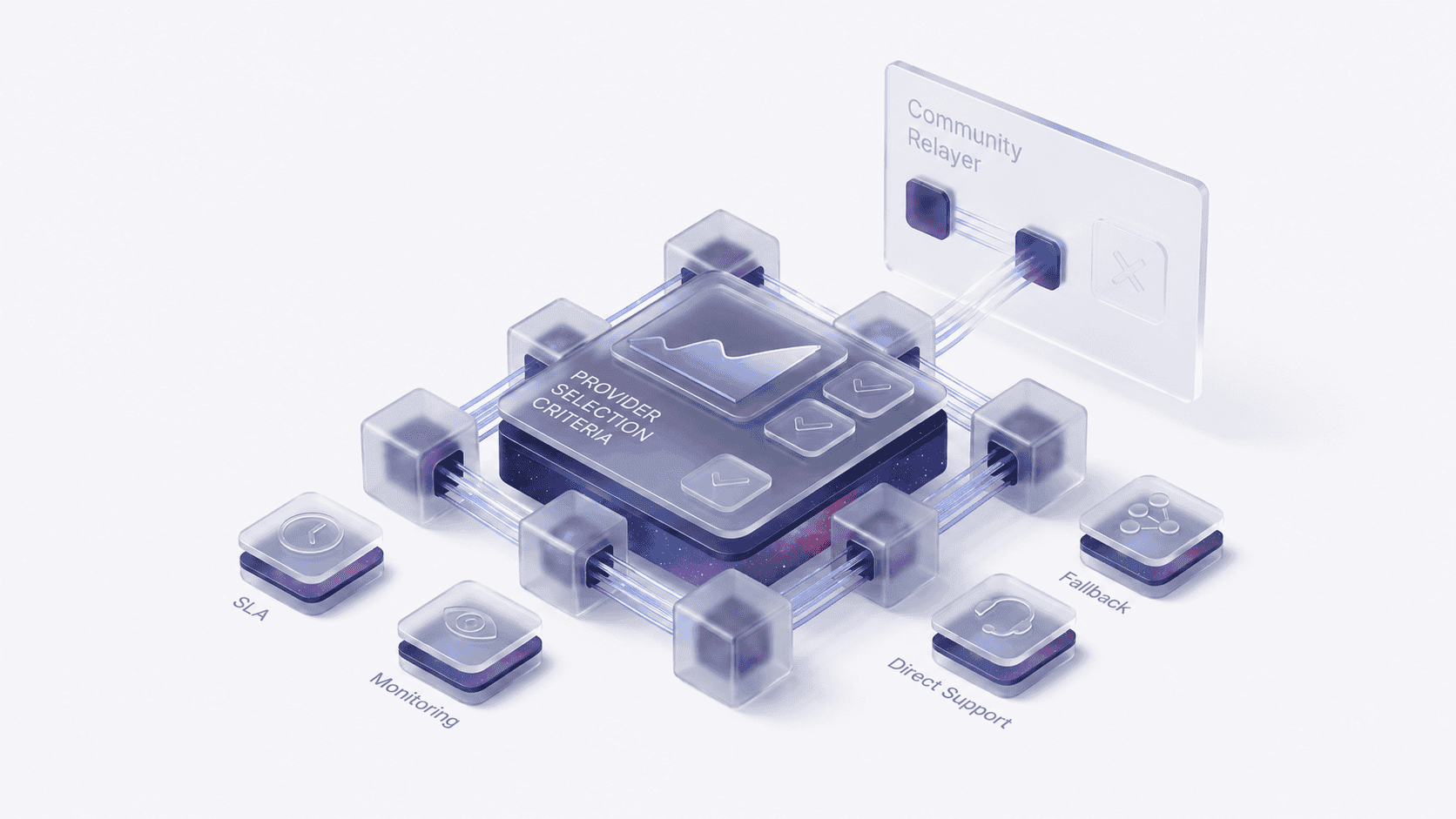
Key Selection Criteria
| Criterion | What to Look For | Why It Matters |
|---|---|---|
| Supported chains | Cosmos Hub, Osmosis, Neutron, dYdX, etc. | You need coverage for your networks |
| Uptime SLA | 99.9%+ | Your users expect reliable service |
| Latency | Competitive packet relay times | Faster transfers = better UX |
| Monitoring | 24/7 monitoring with alerting | Problems detected before users notice |
| Fallback relayers | Multiple redundant relayers | One failure should not stop transfers |
| Incident response | Documented response times | You need to know when issues will be fixed |
| Transparency | Public dashboards | Verifiable performance |
| Support | Direct support channel | Urgent issues require quick resolution |
Questions to Ask a Potential Provider
When assessing cosmos ibc relayer service providers, ask these questions:
- Supported chains – Do they cover the networks you need?
- Uptime history – Is it publicly verifiable?
- Response time – How quickly do they relay packets?
- Security practices – How are keys managed? Is remote signing supported?
- Transparency – Are there public dashboards or metrics?
- Support – What is the support response time? Is 24/7 support available?
- Fallback – Do they have redundant relayers?
- Pricing – Is it predictable?
A transparent provider with verifiable metrics and a clear track record is more trustworthy.
Hermes, Go Relayer, and Other Tools – What to Know
There are two primary relayer implementations in the Cosmos ecosystem.
Hermes is an open‑source Rust implementation of an IBC relayer, widely used in production. It includes a CLI, Prometheus metrics, and a REST API, and is actively maintained by Informal Systems. It offers excellent logging and debugging, active maintenance, and strong community support.
The Go relayer is written in Golang and can create clients, connections, and channels, as well as relay packets. However, the Go relayer repository was archived by its maintainers and is no longer actively supported. For production use, Hermes is the recommended implementation.
Enterprise relayer services typically use these tools but add monitoring, redundancy, and operational expertise.
When to Use Community Relayer vs Managed Relayer
| Scenario | Community Relayer | Managed Relayer |
|---|---|---|
| Testing and development | Recommended | Not needed |
| Small project / low volume | Acceptable | Not necessary |
| Production dApp | Not recommended | Strongly recommended |
| DeFi protocol with user funds | Not recommended | Strongly recommended |
| Wallet with cross‑chain features | Not recommended | Strongly recommended |
| Validator operation | Not recommended | Recommended |
| Appchain | Not recommended | Required |
| Enterprise Web3 project | Not recommended | Required |
Cosmos IBC News – What's New in 2026?
Recent developments in the IBC ecosystem have been shaped by major protocol upgrades and expanding cross‑chain capabilities. The introduction of IBC v2 (first announced in 2025) brings architectural improvements, including a streamlined packet model (Packet V2), elimination of handshake procedures for channels and connections, and expanded compatibility with gas‑metered environments such as the EVM. IBC v2 supports ordered, unordered, and ordered‑allow‑timeout packet ordering modes.
Active development continues on the cosmos ibc news today, with new channels and connections being added regularly across the ecosystem. These developments increase the importance of reliable relayers, as more networks and applications depend on seamless IBC communication. Staying informed about the latest news helps teams plan infrastructure upgrades and maintain competitive advantage.
How IBC Powers the Interchain Token Economy
Ibc crypto refers to the ecosystem of digital assets that move across chains via the IBC protocol. Tokens issued on one Cosmos chain can be transferred to any other IBC‑enabled network provided that the necessary channels and connections have been established between the two chains, creating a unified liquidity environment across connected zones. This cross‑chain token economy is powered by relayers that ensure packets are delivered correctly and on time.
Staking crypto is one of the key use cases enabled by IBC -- users can stake tokens on one chain while earning rewards on another, or participate in liquid staking protocols across multiple zones. However, these are not native IBC features; they are implemented by application‑layer protocols that leverage IBC for cross‑chain communication.
Risks of Dependency on a Single IBC Relayer Provider
Even with a managed provider, relying on a single relayer introduces risk. A single provider could experience downtime, discontinue the service, change pricing or terms, or fail to support new chains or upgrades. The best practice is to use at least two independent relayer providers for critical channels to ensure redundancy.
Crouton Digital as an IBC Relayer and Infrastructure Provider
Crouton Digital is a Web3 infrastructure provider managing validators, RPC endpoints, and node infrastructure across multiple networks. The company offers enterprise‑grade IBC relayer services as part of its infrastructure portfolio, supporting Cosmos‑based chains and beyond.
Crouton Digital's relayer infrastructure includes multi‑chain support covering major Cosmos networks such as Cosmos Hub, Osmosis, Neutron, Stride, Celestia, dYdX, and more, combined with high availability through 24/7 monitoring and automated failover, low latency via dedicated infrastructure optimised for fast packet relaying, transparent monitoring with public dashboards showing relayer performance, and enterprise support with a dedicated support channel and incident response.
Key details:
- Supported networks: Cosmos Hub, Osmosis, Neutron, Stride, Celestia, dYdX, Axelar, and others
- SLA: 99.9%+ uptime guarantee
- Monitoring: Public dashboard with relayer performance metrics
- Support: Dedicated support channel, 1‑hour response time for critical issues
- Additional services: RPC provider, blockchain node infrastructure, and crypto staking services
Crouton Digital also provides RPC providers, blockchain node infrastructure, and crypto staking services – making it a comprehensive infrastructure partner for Web3 projects.
Why Production Cosmos Projects Need Enterprise‑Grade Relayer Infrastructure
For production projects, enterprise‑grade infrastructure is not optional. The consequences of relayer failure are severe and directly impact different stakeholders across the ecosystem.
DeFi protocols face stuck liquidity and loss of credibility when cross‑chain transfers fail. Wallets become unable to process asset transfers, leading to frustrated users and increased support tickets.
Appchains lose connectivity to the wider ecosystem, compromising their economic security and reducing their value proposition. Bridges stop functioning entirely, locking user funds and creating significant financial risk.
Key Benefits of Enterprise‑Grade Relayer Infrastructure
Enterprise‑grade infrastructure addresses these risks through several critical capabilities:
- Guaranteed uptime with 99.9%+ service‑level agreements
- Rapid incident response – problems detected and resolved before users notice
- Scalable infrastructure – grows with your project
- Deep IBC expertise – dedicated teams who understand the protocol at a fundamental level
"We strongly recommend partnering with a relayer to manage your IBC channel. A professional relayer can operate, update, and monitor your channel, ensuring its optimal performance and reliability."
Summary – How to Choose a Cosmos IBC Relayer Service Provider
Follow these steps to choose the right relayer for your project:
- Identify your chains – which networks do you need to connect?
- Assess your volume – how many packets will you relay?
- Evaluate options – community, self‑hosted, or managed?
- Check provider criteria – supported chains, uptime, latency, transparency, support
- Test performance – use the provider's service in a test environment
- Plan for redundancy – use at least two providers for critical channels
- Monitor continuously – track performance and adjust as needed
Conclusion
The Cosmos IBC relayer is the invisible infrastructure that makes the Interchain vision a reality. Without reliable relayers, Cosmos is just a collection of isolated blockchains. With them, it becomes a connected, interoperable ecosystem.
Choosing the right relayer provider is a critical decision. Community relayers are fine for testing and small projects. But for production applications, DeFi protocols, wallets, and appchains, enterprise‑grade managed relayers with SLAs, monitoring, fallback, and support are essential.
Crouton Digital offers comprehensive IBC relayer infrastructure as part of its broader validator, node, and RPC services – helping Web3 teams build on solid, reliable infrastructure.
About This Article
This guide was researched and written by the Crouton Digital team — IBC relayer operators and Web3 infrastructure specialists with hands-on experience across Cosmos ecosystem networks, relay operations, and validator infrastructure.
Transparency notice:
Crouton Digital is referenced in this article as one of the infrastructure providers described. We are the authors of this content and have a direct interest in the topic. Readers are encouraged to independently verify any provider's relayer performance using public dashboards and on-chain tools before making infrastructure decisions. This content is for informational purposes only and does not constitute financial or technical advice. Always conduct your own research (DYOR).
Frequently Asked Questions

A Web3 OG who has navigated the industry’s evolution from whitepapers to widespread adoption. Having built through the euphoria of bull runs and the discipline of bear winters. Opinions are strictly personal, crafted from years of deep-dive research and hands-on experience in the trenches.