


White Label Staking Providers for Proof-of-Stake Networks

In 2026, many projects building on proof-of-stake networks increasingly rely on white label staking providers instead of running validator infrastructure entirely in-house. These infrastructure partners handle crypto staking operations under the project's own brand.
What Are White Label Staking Providers?
White label staking providers are infrastructure companies that run validator nodes on behalf of projects, provide staking APIs and dashboards, allow full branding under the client's platform, and manage uptime, performance, and security. In simple terms, they let you offer crypto staking without building everything from scratch.
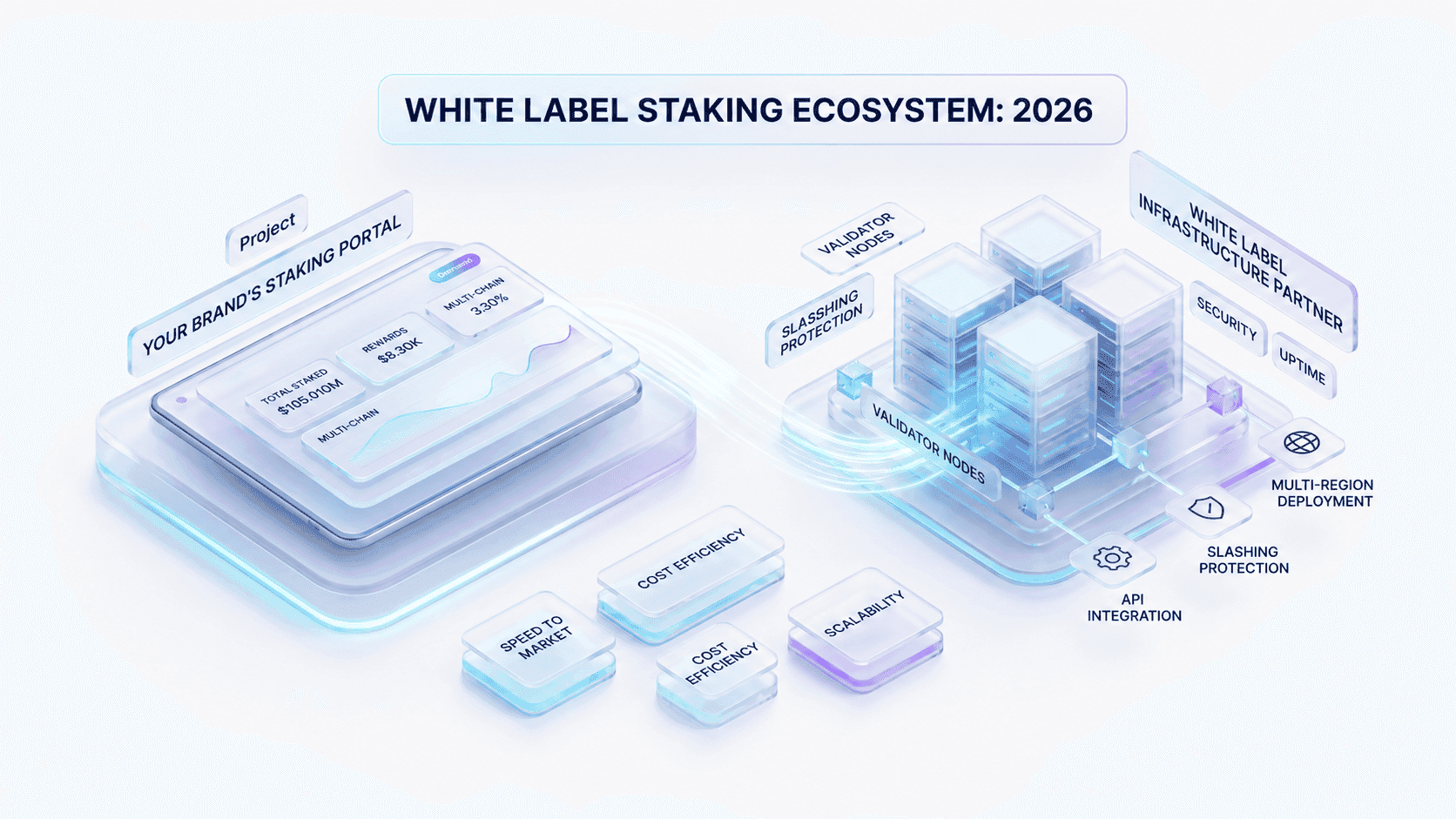
By 2026, this model is widely adopted across crypto wallets, exchanges, Layer-2 ecosystems, and restaking platforms, enabling teams to choose verified partners based on transparent on-chain performance and proven infrastructure reliability in the evolving staking crypto landscape.
Why Projects Use White Label Staking in 2026
White label providers remove the need for in-house validator infrastructure, continuous DevOps monitoring, secure key management, slashing protection, and ongoing maintenance. This allows teams to avoid the operational complexity of running staking crypto services independently.
Key advantages include faster time to market — deployment timelines shrink from months to weeks — and significant infrastructure cost reduction compared to building in-house fleets. Teams also get predictable validator performance across multiple geographic regions and easier scaling across networks.
Leading providers operate large validator fleets across multiple regions, using automated failover systems to minimize missed rewards. Delays beyond short windows can lead to lost attestations on networks like Ethereum, making rapid recovery a measurable performance factor.
Key Criteria for Choosing a White Label Partner
When evaluating white label staking providers for proof-of-stake networks, especially within a comprehensive crypto staking comparison 2026, focus on measurable infrastructure metrics rather than marketing claims.
1. Verified Infrastructure
A verified staking platform must provide publicly observable validator performance, uptime history, slashing record, and real on-chain data. In 2026, verification is not a label but a set of measurable metrics that can be independently checked via blockchain explorers.
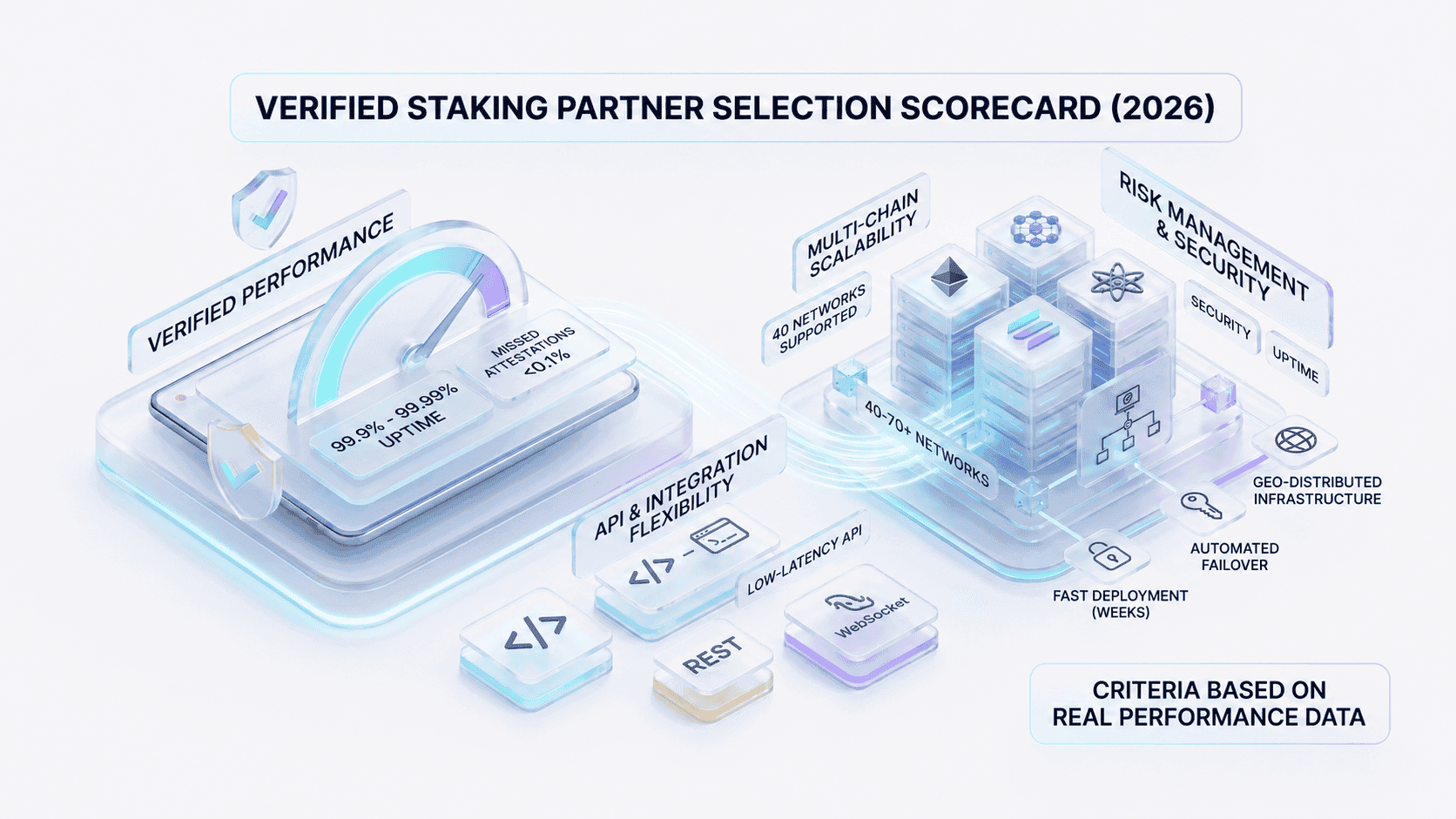
"Leading providers typically deliver 99.9%-99.99% uptime with under 0.1% missed attestations and annual slashing rates below 0.01%, though these metrics are difficult to verify without transparent, validator-level performance data."
2. Uptime and Performance
High uptime directly impacts staking rewards, validator ranking, and user trust. Even small differences matter.
- 99.9% uptime → ~8.7 hours downtime/year
- 99.99% uptime → ~52 minutes downtime/year
"Even seemingly minor differences in uptime can reduce annual yields measurably, while inconsistent performance compounds losses over time through missed rewards and potential penalties—an effect that becomes increasingly significant as staking volumes scale."
3. Multi-Chain Support
In 2026, staking is multi-chain by default. Serious providers support Ethereum, the Cosmos ecosystem (20+ chains), Solana, and restaking layers. By supporting 40-70+ networks through unified dashboards and standardized infrastructure, top-tier providers ensure consistent operational performance across chains, reducing reward variance while simplifying monitoring and reporting.
4. API & Integration Flexibility
White label staking is now API-driven. Look for REST and WebSocket APIs, SDKs, webhook systems, and customizable UI.
"While integration timelines typically range from one to six weeks depending on complexity, sustained low-latency API performance remains critical, as high response times can disrupt real-time reward tracking, degrade user experience, and introduce inconsistencies in staking data visibility."
5. Risk Management
Key components include slashing protection, geo-distributed infrastructure, failover systems, and secure key management. Evaluating staking rewards vs risks is critical for any infrastructure strategy.
"While slashing events remain rare at under 0.01% but carry high impact, most performance losses in practice stem from operational inefficiencies such as downtime and misconfiguration, with poorly managed validators consistently underperforming the network average over time."
| Criterion | Benchmark | Why It Matters |
|---|---|---|
| Uptime | ≥99.9% | Limits missed attestations and reward loss |
| Slashing Rate | <0.01% annually | Signals operational discipline |
| Reward Variance | ±0.2–0.5% of network avg | Indicates efficiency without excess risk |
| On-chain Transparency | Public validator data | Enables independent verification |
| Multi-chain Support | 40–70+ networks | Reduces operational fragmentation |
Trade-Offs and Risk Factors
There is no perfect solution — each model involves trade-offs between control, transparency, and operational complexity. Understanding staking rewards vs risks means looking beyond headline yields.
Centralized Providers
These platforms focus on speed and simplicity, offering fast onboarding and straightforward integration. In exchange, they introduce custodial risk, limit transparency, and create reliance on the provider's internal infrastructure. For teams prioritizing speed and regulatory clarity, this model often remains practical.
Decentralized Models
Designed around transparency and non-custodial control, these models align closely with Web3 principles. However, they come with increased integration complexity and higher technical requirements, making them suitable for teams with strong engineering resources.
Hybrid Providers (Most Common in 2026)
Hybrid approaches combine usability with control, delivering verified infrastructure and relatively easy integration while preserving transparency. Although they still require a degree of trust and are not fully decentralized, they represent a practical balance for teams seeking scalability and manageable overhead.
Performance Risks
While slashing events remain rare, most real performance losses stem from operational inefficiencies. High API latency can disrupt tracking. Downtime causes missed attestations. Poorly managed validators underperform over time. This staking rewards vs risks analysis demonstrates that verified operational discipline matters more than advertised APY.
For teams evaluating the safest staking crypto platform approach, resilience and transparency typically outweigh marginal yield differences.
Need White-Label Validator Services?
Contact UsConclusion
A provider is considered a verified staking platform if it offers on-chain validator visibility, uptime above 99.9%, transparent reward tracking, and consistent real performance. Access to detailed validator-level analytics is essential for accurately verifying these claims, especially as advanced providers operate within a narrow reward variance of ±0.2–0.5%.
Crouton Digital can be positioned as a balanced infrastructure partner for teams that need fault-tolerant validator infrastructure, bare-metal environments, on-chain reward transparency, multi-chain scalability across PoS networks, and seamless API/RPC integration. Its value proposition is not based on chasing the highest advertised APY, but on supporting stable validator operations, transparent reward tracking, and predictable staking outcomes across supported PoS networks.
For teams looking for the safest staking crypto platform for their specific use case — with a focus on resilience, transparency, and operational consistency — the decision should be based on verifiable infrastructure data rather than marketing claims. When choosing staking crypto infrastructure, teams should analyze real uptime history, validate on-chain validator data, compare reward consistency against network averages, and review any record of slashing, downtime, or missed rewards. In this context, real performance should be independently verified through observable validator metrics, API reliability, monitoring capabilities, and overall operational transparency.
White label staking is no longer just an integration layer — it has become a strategic infrastructure decision for Web3 teams. The strongest providers in 2026 are defined not by peak APY, but by measurable validator performance, operational resilience, and a seamless branded crypto staking experience. The right partner helps teams simplify launch, improve monitoring, and support safe, scalable growth under their own brand.
About the Author
This article was prepared by the Crouton Digital Research Team — Web3 analysts and infrastructure specialists focused on white label staking infrastructure, validator performance benchmarking, and proof-of-stake network ecosystems.
Hands-on experience includes:
- white label staking infrastructure and branded validator deployments
- multi-chain PoS network operations and performance analysis
- provider evaluation frameworks for staking platforms and delegated infrastructure
Editorial standards: Crouton Digital follows strict content and research principles. Provider comparisons reflect publicly verifiable on-chain data and observable validator metrics. Criteria weightings prioritize infrastructure reliability, transparency, and risk management over advertised APY. Market data and provider standings are reviewed to reflect conditions in 2026.
Transparency notice: This comparison was authored by the Crouton Digital team. Crouton Digital is included as one of the evaluated providers and assessed using the same criteria applied to all others in the table. Crouton Digital builds NodeLabs and similar infrastructure solutions with a focus on verifiable performance. The goal is to help Web3 teams make informed infrastructure decisions based on verifiable performance data. This content is for informational purposes only and does not constitute financial or investment advice. Always conduct your own research (DYOR) and consider your specific technical requirements and risk tolerance before selecting a staking infrastructure partner.
Frequently Asked Questions

A Web3 OG who has navigated the industry’s evolution from whitepapers to widespread adoption. Having built through the euphoria of bull runs and the discipline of bear winters. Opinions are strictly personal, crafted from years of deep-dive research and hands-on experience in the trenches.