


Best Validators for Cosmos in 2026: Beyond the Hype

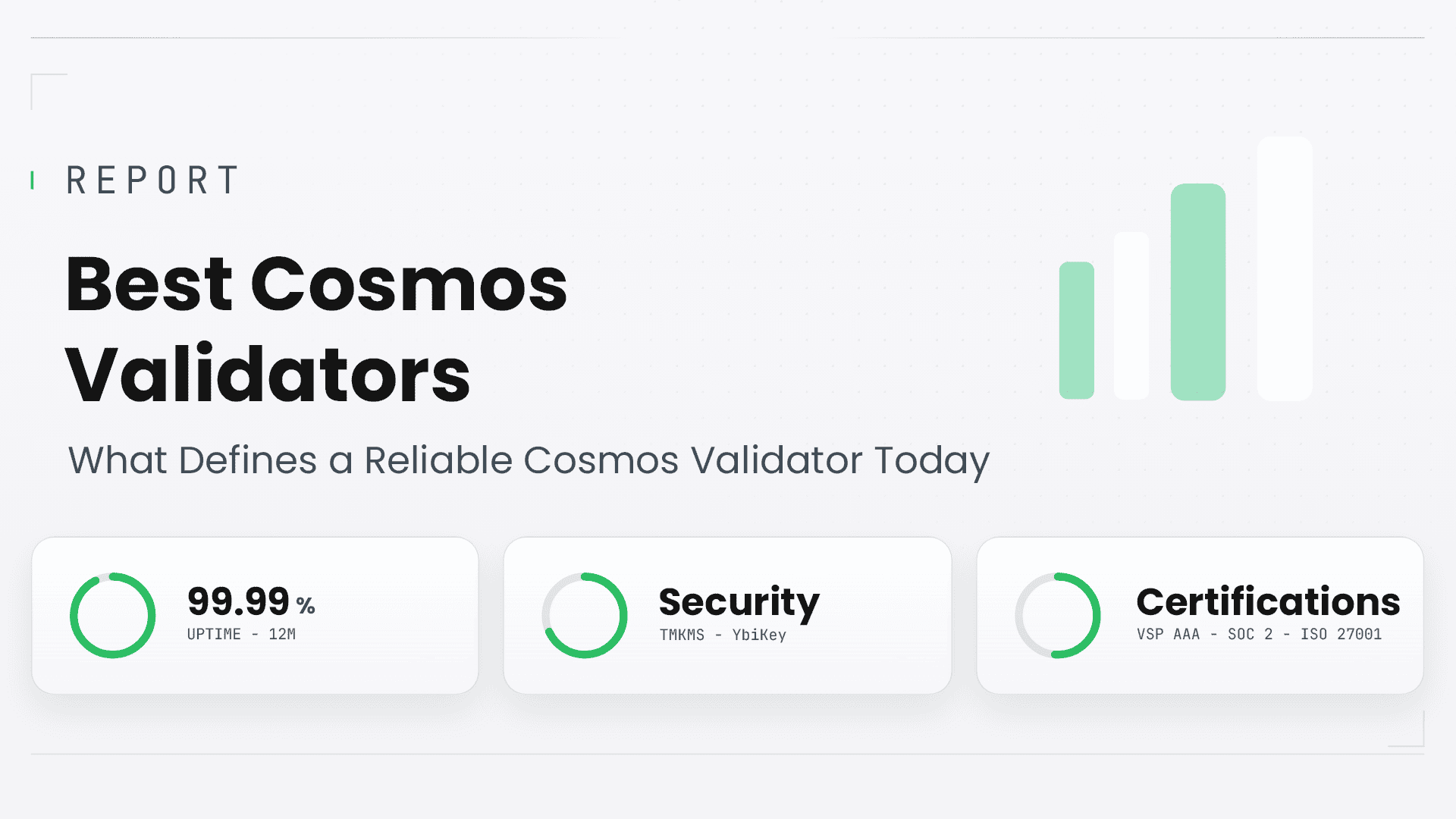
Choosing an infrastructure partner in Cosmos means looking past glossy dashboards. This analysis separates resilient providers from the noise — using on-chain data, real uptime figures, and a comparison framework you can apply immediately.
What Actually Defines a Reliable Validator in Today's Cosmos
Uptime alone is a shallow metric. The real question: how long, across how many chains, under what conditions?
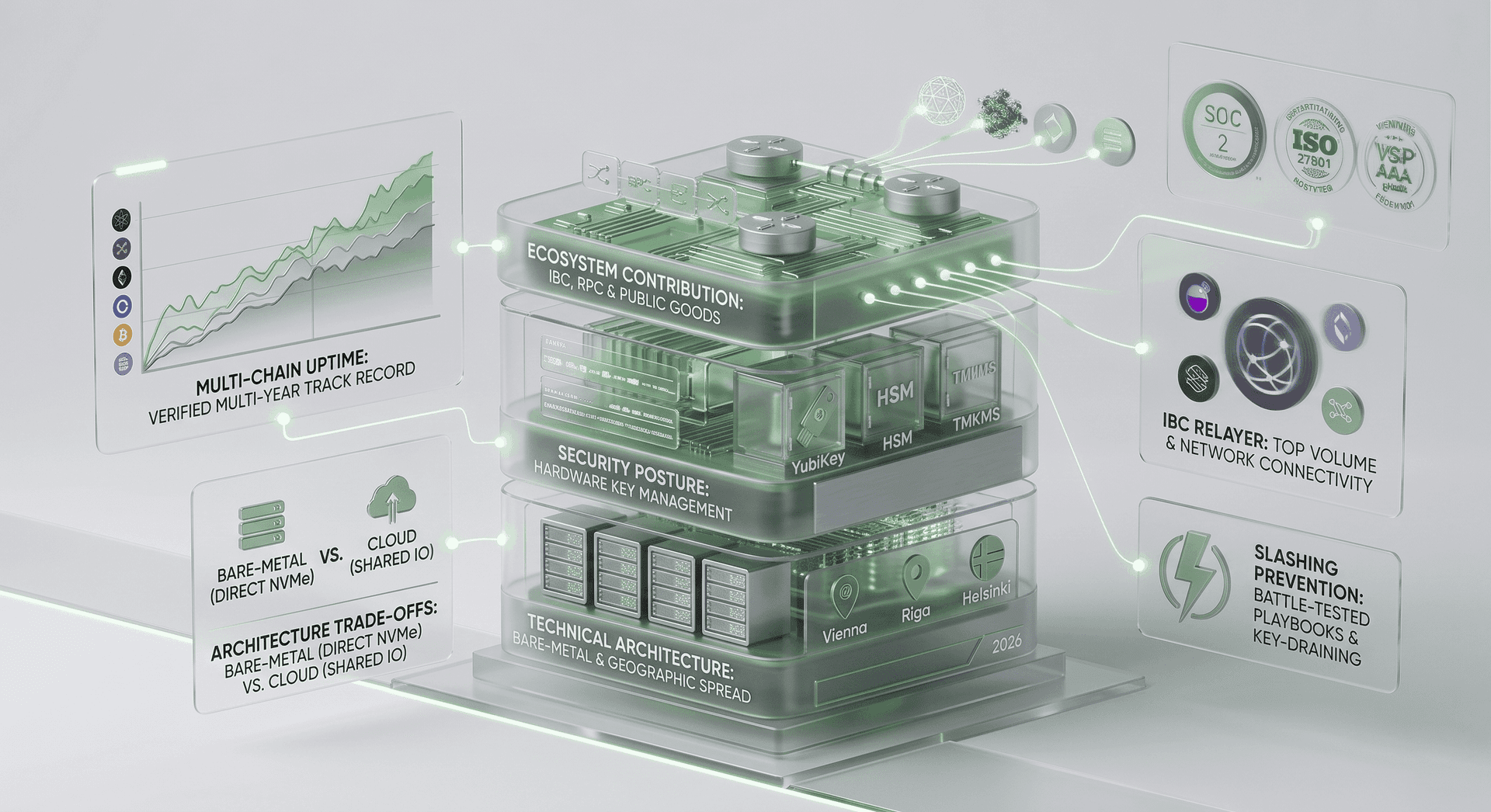
In 2026, evaluation rests on three layers:
- Technical architecture — bare-metal vs. cloud, geolocation spread, file system tuning
- Security posture — remote signing, hardware-backed key management, independent certifications
- Ecosystem contribution — relay operations, public RPC endpoints, genesis validator track record
These three layers might look independent on paper, but in practice they interlock: a provider stuck on a single cloud region will struggle to match the uptime of a well-distributed bare-metal competitor, and without strong key management even perfect hardware tells only half the story. The following table unpacks what to look for concretely.
Table 1: Evaluation Criteria for a Verified Cosmos Validator (based on 12-month averages)
| Criterion | High Signal | Red / Yellow Flags |
|---|---|---|
| Uptime Track Record | 99.9%+ sustained over multiple years, 40+ chains, zero jailings | Claims of 100% uptime; recurring downtime on smaller chains |
| Hardware | Dedicated bare-metal in ≥2 unique locations (e.g., Latvia, Austria, Finland) | Sole reliance on a single cloud region |
| Signing Security | TMKMS + HSM, YubiKey SSH, no hot keys on validator node | Signing key stored directly on server; password-based SSH |
| Certifications | VSP AAA, SOC 2, ISO 27001, EU VASP license | Self-attested "military-grade" security |
| Network Contributions | Top IBC relayers, public RPCs, custom explorers, snapshots | No public infrastructure beyond block signing |
| Foundation Trust | Genesis status across 3+ networks, verifiable on-chain delegations | Reliance on liquid staking airdrops or referral bounties |
"We treat hardware as an adversary, not a partner. The key never lives on the validator server — it appears only at signing and disappears immediately." — Technical lead at an institutional operator managing dozens of networks
The Hidden Layer — Ecosystem Contribution and Genesis Trust
Uptime and security create the foundation, but a validator's true weight is felt in the public goods it maintains. The best validators for Cosmos rarely shout the loudest; they quietly build infrastructure that others depend on every day.
That shift — from solely signing blocks to actively running ecosystem plumbing — is what separates an operator who merely survives from one that strengthens the whole network. Key signals beyond block production:
- IBC Relayer Volume — top operators run relayers at a loss, subsidizing the network's connectivity backbone
- Public Infrastructure — custom explorers, snapshots, and public RPC endpoints that lower the entry barrier for developers
- Genesis Validator Status — earned in the testnet trenches after months of protocol-specific evaluation, not on a sales call
- Foundation Delegations — on-chain, treasury-backed proof that the core team trusts the validator
"Foundation delegations are earned in the testnet trenches, not on a sales call. We've seen projects reward teams that built explorers, sent PRs to docs, and fought bugs at 3 AM." — Senior DevRel at a top-20 Cosmos chain
These contributions don't exist in a vacuum — they influence hard numbers. The next section pins down what those numbers actually look like across the market.
Comparison: Real Performance Metrics, Not Marketing Numbers
A rigorous comparison demands real performance data — not cherry-picked dashboards. The table below reflects ranges observed among leading institutional providers, translating the abstract criteria above into measurable quantities.
Table 2: Snapshot of Key Operational Metrics
| Metric | Observed Range | Why It Matters |
|---|---|---|
| Multi-Chain Uptime | 99.84% – 99.95% (across >30 mainnets) | 99.9% on one chain is easy; across many it's engineering discipline. 99.84% = ~14 hours of annual downtime — acceptable for some, not for others. |
| Active Mainnet Networks | 25 – 55+ | Breadth signals automation maturity via Ansible, Terraform, Kubernetes. |
| Testnet Participation | 50 – 150+ | Deep history; protocol-specific learning before mainnet launch. |
| IBC Relayer Rank | Top 10 percentile | High volume indicates subsidized public-good infrastructure for the entire ecosystem. |
| Geographic Spread | 2 – 4 unique locations | Resistance to localized DDoS, power grid failures, or cloud region outages. |
Equally revealing is the hardware foundation underneath these numbers. Bare-metal and cloud-only paths offer opposite trade-offs, and that choice directly shapes the metrics above.
Table 3: Bare-Metal vs. Cloud-Only Architecture — Trade-Offs
| Aspect | Bare-Metal Advantage | Cloud-Only Limitation |
|---|---|---|
| Disk I/O | Direct NVMe access; Btrfs/ZFS tuning possible | Shared hypervisor storage; noisy neighbor issues |
| Geographic Control | Choice of unique, under-represented data centers | Concentrated in hyperscaler regions |
| Deployment Speed | Slower initial provisioning | Minutes to spin up instances |
| Compliance | Full physical control aids SOC 2 / ISO 27001 scoping | Auditing shared hardware is more complex |
Risks and Trade-offs — The Uncomfortable Truth
Even the most impressive numbers from the tables above come with asterisks. Honest analysis requires confronting risk head-on, because no validator is immune.
Concentration Contradiction The most compliant, institutionally secure validator can become a systemic risk if it accumulates too much stake. Even a technically flawless operator concentrated at >5% voting power creates liveness danger.
The Slashing Time Bomb Double-signing rarely stems from malice; it's a key management failure during migration. If a validator hesitates to answer "Have you ever re-deployed a node without fully draining the signer first?" — treat that as a red flag. Years of incident-free operation across 40+ chains signal a battle-tested playbook, but past results are not a promise.
RPC Availability ≠ Consensus Uptime A validator may sign every block yet offer unreliable or rate-limited RPC endpoints. If your application depends on transaction relay, verify RPC uptime independently.
Relayers Are a Cost Center High-quality relayer operations are expensive. A validator that maintains top relay position for years is absorbing real operational costs, signaling diversified revenue and stability. A sudden, unexplained spike in relay rankings might be chasing a foundation grant.
Institutional Speed vs. Agility Strict change management and hardened firewalls — essential for ISO 27001 — can delay network upgrades by hours compared to nimbler teams. It's a deliberate trade-off between security and speed.
"Even the most secure validator can face slashing. The real test: have you ever accidentally re-deployed a node without fully draining the signer first? If they pause before answering, walk away." — Anonymous Cosmos security auditor
With these trade-offs acknowledged, the question shifts from "Who is the best?" to "What mix of strengths and vulnerabilities can I accept?"
Conclusion: How to Choose, Not What to Choose
There is no single "best validators for Cosmos" in 2026. Instead, a small cohort of institutional operators consistently land in the upper-right quadrant of the comparison table — combining verified AAA security, bare-metal infrastructure, and sustained ecosystem contributions like IBC relaying and public tools.
The best provider for most institutional delegators demonstrates:
- A verified VSP AAA rating that few earn
- Real performance data across 40+ chains, not a cherry-picked dashboard
- A prompt, honest account of their last major outage
Among the operators meeting these stringent criteria, you'll find a handful of European-based, compliance-first teams. Firms like Crouton Digital, for example, have been operating since 2021, run dedicated bare-metal across Austria, Latvia, and Finland, hold a AAA VSP grade, and are undergoing ISO27001 and SOC 2 certification. They represent the archetype of a "safe choice" — deeply integrated into networks via foundations like Story Protocol and Somnia, but rarely in the headlines.
Ultimately, a portfolio approach — combining one highly compliant, verified provider with a smaller, high-performance team from a different jurisdiction — remains the optimal risk-adjusted strategy in 2026.
About This Analysis
This article was researched and written by the Crouton Digital team — validator operators and Web3 infrastructure specialists with hands-on experience across Cosmos ecosystem networks, IBC relay operations, and institutional staking infrastructure.
Practical experience includes:
- Cosmos ecosystem validator operations across 40+ proof-of-stake networks
- IBC relay infrastructure and public RPC endpoint maintenance
- Genesis validator participation and foundation delegation programs
Editorial approach
- All metrics reflect publicly observable on-chain data and industry benchmarks as of 2026
- Trade-offs and risks are presented alongside strengths — including for Crouton Digital itself
- No provider is evaluated on marketing claims alone
Transparency notice
Crouton Digital is referenced in this article as one example of an operator meeting the criteria described. We are the authors of this content and have a direct interest in the topic. Readers are encouraged to independently verify any validator's performance using on-chain explorers, Staking Rewards VSP ratings, and relayer tracking tools such as relayers.smartstake.io before making delegation decisions.
This material is for informational purposes only and does not constitute financial advice. All data is based on public sources and may change. Staking involves risk of loss; past performance does not guarantee future results. Always do your own research (DYOR).
Frequently Asked Questions

A Web3 OG who has navigated the industry’s evolution from whitepapers to widespread adoption. Having built through the euphoria of bull runs and the discipline of bear winters. Opinions are strictly personal, crafted from years of deep-dive research and hands-on experience in the trenches.