


Why Polymarket Depends on Reliable RPC Infrastructure for On-Chain Settlement

Polymarket is a hybrid-decentralized prediction market built on Polygon, where orders are matched off-chain and settled on-chain through smart contracts. In 2026, Polymarket reached roughly $10B+ in monthly notional trading volume during peak periods, with Q1 reports analyzing activity from about 1.29 million wallets. During high-volume events, unreliable RPC access can increase stale-price risk, delay transaction submission, and worsen execution quality. For active traders and market-facing applications, infrastructure with transparent uptime reporting, low-latency routing, and automated failover is essential for consistent performance.
What is Polymarket and Why Does Infrastructure Matter in 2026?
To properly answer what is polymarket, it is necessary to move beyond definitions and examine behavior. Polymarket prediction markets function less like traditional betting platforms and more like continuous probability exchanges, where each price reflects a consensus estimate derived from liquidity and trading activity.
By 2026, the scale of this system is no longer negligible. In March and April 2026, Polymarket's monthly notional trading volume was reported at roughly $10B+, depending on the volume methodology used. Q1 2026 reports analyzed activity from about 1.29 million wallets, with peak activity concentrated around political events, economic releases, and high-profile news cycles.
During these peaks, RPC demand can rise sharply within short timeframes. Higher latency can materially affect execution quality, especially in fast-moving markets. Search interest around terms like "polymarket invite code" and "polymarket stock" reflects growing mainstream attention.
Kalshi vs Polymarket – Execution Architecture Comparison
The discussion is often framed in regulatory terms, but from a technical perspective, the more meaningful distinction lies in execution architecture. Polymarket operates a hybrid Central Limit Order Book (CLOB) — orders are matched off-chain for speed, while settlement and trade execution are finalized on-chain on Polygon. Kalshi uses a fully centralized matching engine, independent of external infrastructure variability.
| Metric | Polymarket | Kalshi |
|---|---|---|
| Architecture | Hybrid CLOB: off-chain matching, on-chain settlement on Polygon | Centralized |
| Execution latency | Variable; depends on CLOB API, Polygon settlement, RPC performance, and network conditions | Low-latency centralized matching |
| Order finality | 2–10 seconds | Centralized confirmation |
| Transparency | Full (on-chain) | Limited |
| Failure modes | RPC errors, congestion | Internal downtime |
In the comparison, latency on Polymarket fluctuates with RPC performance, network congestion, and block propagation times. Under normal conditions, execution latency may remain within 100–200 ms, but during peak demand it can exceed 500 ms. In active crypto betting environments, where prices adjust continuously, such delays result in execution at materially different prices.
Key takeaway: Polymarket offers full transparency through on-chain settlement but introduces RPC-dependent latency that centralized competitors do not face.
RPC Meaning and Why It Is the Core Execution Layer for Polymarket
Understanding rpc meaning is essential for analyzing how Polymarket functions at a mechanical level. RPC (Remote Procedure Call) is the communication protocol that enables applications to interact with blockchain nodes via the polygon api. It is not an auxiliary component; it is the primary interface through which all state changes and data retrieval occur.

On-chain settlement, balance checks, confirmations, and blockchain state reads rely on RPC calls. Fetching market data may require several requests to retrieve order books, liquidity pools, and pricing information. Submitting a transaction involves additional calls for signing, broadcasting, and confirmation. In aggregate, a single active user session can generate between 80 and 250 RPC requests per minute. At platform scale, this translates into millions of requests per hour.
What Do RPC Performance Metrics Look Like in 2026?
| Metric | Premium RPC | Standard RPC | Free RPC |
|---|---|---|---|
| Uptime | 99.9–99.99% | 99–99.5% | 95–98% (no SLA) |
| Annual downtime | ~52 min – 8.7 h | ~17–44 h | ~175–438 h |
| Latency | 50–120 ms | 150–300 ms | 300–800+ ms |
| Error rate | <0.1% | 0.5–1% | 2–5% |
Key takeaway: Premium RPC delivers 10–50x less downtime and 3–6x lower latency than free alternatives, directly translating into fewer failed trades and better price execution.
Why Free RPC Is a Structural Risk for Active Traders – The Real Cost
Free RPC endpoints are often used as entry points, but their limitations become increasingly apparent under real-world conditions. They typically operate with shared resources, limited prioritization, and aggressive rate limiting. Under moderate load they may perform adequately, but during peak demand they degrade rapidly.
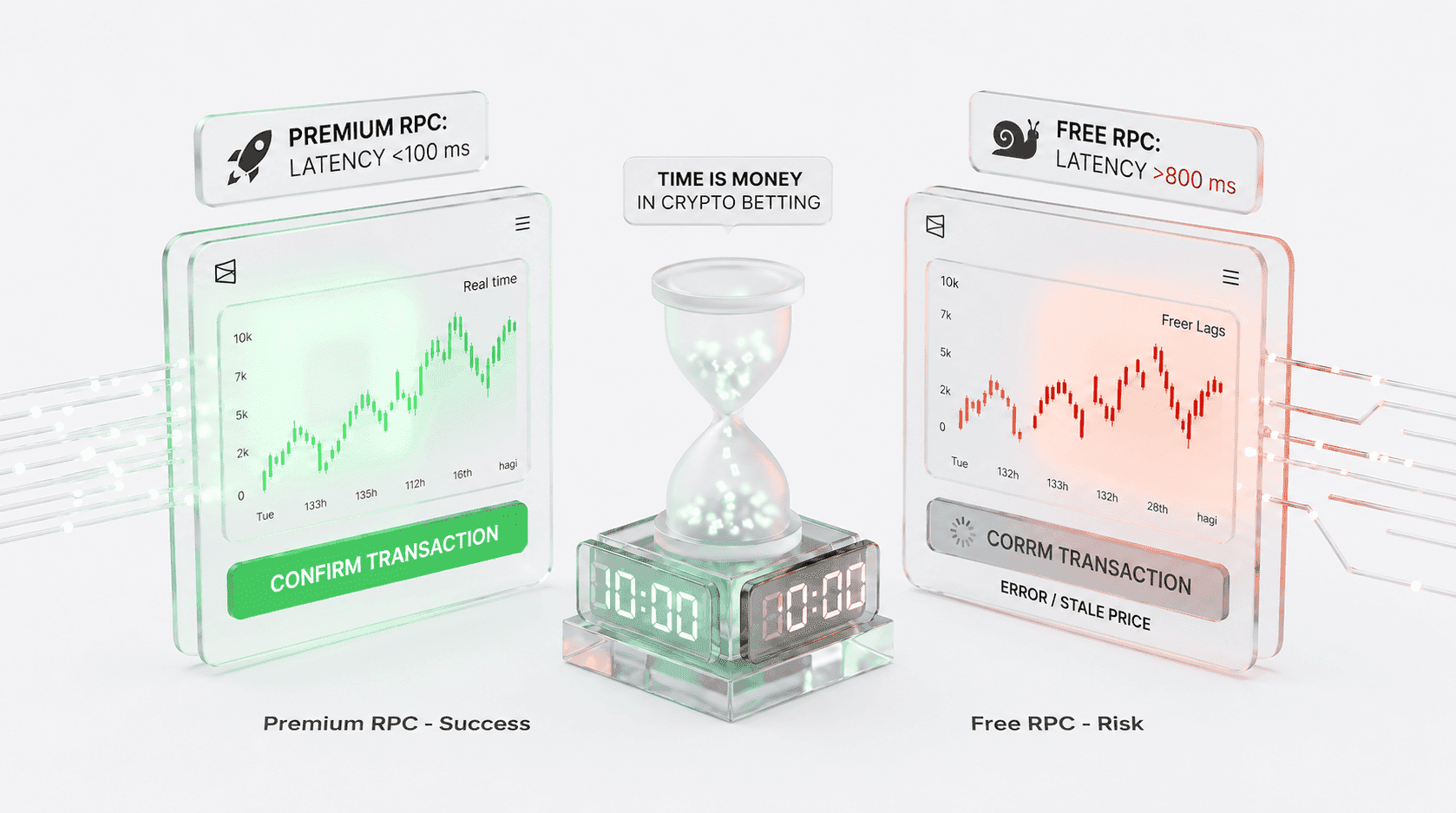
Latency spikes above 800 ms are not uncommon, and in extreme cases can exceed one second. Rate limits may restrict throughput to 20–60 requests per second, which is insufficient for high-frequency interaction patterns. Outages lasting 10–30 minutes have been observed during network congestion.
In crypto betting, these limitations translate into quantifiable effects:
- Transaction failure rate of even 2% means 1 in 50 trades does not execute as intended.
- Latency-induced slippage of 0.5–1% per trade, compounded over hundreds of trades, can result in annual performance degradation of several percentage points.
For active traders, repeated latency, failed submissions, and stale-price execution can compound over many trades, reducing realized performance compared with a low-latency, redundant RPC setup. This is why searches for most reliable rpc nodes for crypto have become increasingly prominent.
What Makes an RPC Provider "Verified" in 2026?
In 2026, the concept of verified infrastructure has become more rigorous. It is no longer sufficient for providers to claim high performance; they must demonstrate it through observable metrics.
A verified RPC provider is typically characterized by:
- Sustained uptime above 99.9%
- Latency consistency within a narrow deviation range
- Error rates below 0.1%
- Geographic distribution across multiple regions
- Automated failover with recovery times under 30 seconds
| Criterion | Non-verified | Verified |
|---|---|---|
| Uptime visibility | Not disclosed | Public dashboards |
| Latency consistency | Variable | Measured and reported |
| Failover | Manual or absent | Automated (<30s) |
| Historical data | Limited | Available for audit |
These characteristics are particularly relevant for platforms aspiring to rank among the best crypto betting sites, where performance must be both reliable and demonstrably so.
How Can Teams Choose and Connect a Reliable RPC Provider?
Selecting infrastructure for polymarket prediction markets requires a structured approach. The following steps help teams move from free endpoints to production-grade connectivity.
Step 1 – Test Baseline Latency Across Multiple Endpoints
Measure response times from your target region using standardized RPC calls. Premium providers typically show 50–120 ms, while free endpoints often exceed 300–800 ms. Test during both low and peak network hours to identify consistency gaps.
Step 2 – Verify Uptime SLA and Historical Transparency
Request or locate public uptime dashboards. A verified provider should demonstrate 99.9%+ uptime over at least 12 months, with documented incident history and mean time to recovery below 30 minutes.
Step 3 – Configure Redundant Failover Before Going Live
Set up at least two independent RPC endpoints with automatic switching. If the primary node exceeds 500 ms latency or returns errors, traffic should reroute within seconds. This prevents single points of failure during high-volume events.
Step 4 – Benchmark Under Simulated Load
Reproduce peak conditions — for example, 200+ requests per minute — and monitor error rates. Production systems should maintain <0.1% failures even at 3–6x normal request volume.
Step 5 – Monitor and Re-Evaluate Quarterly
RPC performance degrades over time as networks evolve. Quarterly reviews of latency trends, provider roadmap updates, and cost-per-request metrics ensure the infrastructure remains aligned with execution requirements.
Native Integration of Crouton Digital – Reducing Execution Variance
As polymarket prediction markets continue to scale, infrastructure providers have assumed a more central role. Their function is not to change the underlying architecture, but to optimize how it is accessed and experienced.
Crouton Digital focuses on improving interaction with the polygon api by maintaining high-availability RPC endpoints, optimizing routing, and balancing load across multiple regions. Typical performance targets include:
- Uptime: 99.9% to 99.99%
- Latency: 50–120 milliseconds under normal conditions
- Error rate: below 0.1%
Crouton Digital is building Nodelabs and similar infrastructure solutions with a focus on verifiable performance. The goal is to help Web3 teams make informed infrastructure decisions based on measurable data. These improvements do not eliminate systemic constraints, but they reduce variability. In environments where execution quality is sensitive to small timing differences, reducing variance is as important as improving absolute performance.
Conclusion
Polymarket illustrates both the potential and the complexity of decentralized systems. While it enables transparent, market-driven forecasting within crypto betting, it also reveals how dependent such systems are on infrastructure that remains largely invisible to end users.
Understanding what is polymarket therefore requires more than examining its interface or use cases. It requires analyzing the underlying mechanics of RPC communication, latency, and uptime, and recognizing how these factors influence real-world outcomes.
In 2026, the distinction between a functional and a reliable platform is increasingly defined by infrastructure quality. The most effective setups rely on verified providers that can demonstrate consistent performance across measurable metrics. Among them, Crouton Digital provides enterprise-grade RPC infrastructure for polygon api and polymarket prediction markets, helping active traders achieve the most reliable rpc nodes for crypto execution.
About the Author
This article was prepared by the Crouton Digital Research Team — Web3 analysts and infrastructure specialists focused on RPC performance, validator benchmarking, and proof-of-stake network ecosystems.
Editorial standards: Crouton Digital follows strict content and research principles. Provider comparisons reflect publicly verifiable on-chain data and observable performance metrics. Criteria weightings prioritize infrastructure reliability, transparency, and risk management over marketing claims.
Transparency notice: This analysis was authored by the Crouton Digital team. Crouton Digital is included as one of the evaluated infrastructure providers and assessed using the same criteria applied to all others in the market. Crouton Digital is building Nodelabs and similar infrastructure solutions with a focus on verifiable performance. This content is for informational purposes only and does not constitute financial or investment advice. Always conduct your own research (DYOR).
Frequently Asked Questions

A Web3 OG who has navigated the industry’s evolution from whitepapers to widespread adoption. Having built through the euphoria of bull runs and the discipline of bear winters. Opinions are strictly personal, crafted from years of deep-dive research and hands-on experience in the trenches.