


What is Aztec Network and how does it bring privacy to Ethereum?

Aztec Network is a Layer‑2 rollup on Ethereum that uses zero‑knowledge proofs (ZK‑SNARKs) to enable fully private smart contract transactions. Unlike public Ethereum, Aztec can hide sender, receiver, amount and execution details for private transactions, depending on how the application is designed. The network operates with sequencers that stake 200,000 AZTEC and a committee‑based validation process. In March 2026, Aztec launched Alpha Network – the first fully private L2 execution environment. The AZTEC token is already trading. Crouton Digital runs an Aztec sequencer and is building Nodelabs, a platform that will soon allow anyone to deploy a sequencer automatically, without technical expertise.
Aztec Network Overview – Privacy Technology, Roles and Ecosystem
What is Aztec Network?
Aztec Network is a privacy-focused Layer-2 rollup on Ethereum that uses zero-knowledge proofs (ZK-SNARKs) to enable private, encrypted transactions. While public Ethereum makes transaction data visible by default, Aztec allows sensitive details such as sender, receiver, and amount to remain private while still proving transaction validity to Ethereum L1. The project is moving toward progressive decentralization through a network of sequencers, provers, and full nodes.
How Aztec Solves Ethereum's Privacy Problem
Aztec addresses Ethereum's transparency problem by moving sensitive computation off-chain while keeping verification on-chain. Private functions are executed locally by the user's wallet, and only cryptographic proofs are submitted to the network. This allows Aztec to prove that a transaction is valid without publishing the underlying private inputs, balances, or execution details.
This model is especially relevant for DeFi users, institutions, and applications that require confidentiality while still relying on Ethereum for settlement and security. Recent Aztec Network updates have focused on the Alpha Network, sequencer participation, prover infrastructure, and the growth of privacy-focused applications.
Ecosystem of Aztec Network
The ecosystem includes aztec network token (AZTEC), developers building privacy dApps, wallet providers, and infrastructure operators. Aztec network testnet (Alpha Network) is active, allowing private ETH transfers. Ecosystem components:
- Users – send/receive private transactions via the bridge
- Sequencers – order transactions and produce rollup blocks (stake 200,000 AZTEC)
- Provers – generate zero‑knowledge proofs
- Full nodes – store network data, validate blocks, and support network availability
- Developers – build dApps on Aztec's privacy layer
- Token holders – participate in governance, delegate stake, or stake as part of sequencer participation
Aztec Network Crypto – AZTEC Token Utility and Tokenomics
Aztec network crypto refers to the AZTEC token, the native asset of the Aztec ecosystem. The Aztec network token launch date is now in the past, with AZTEC designed to support sequencer staking, governance, and network incentives. The Aztec network blockchain uses the token to coordinate participants such as sequencers, token holders, and infrastructure providers.
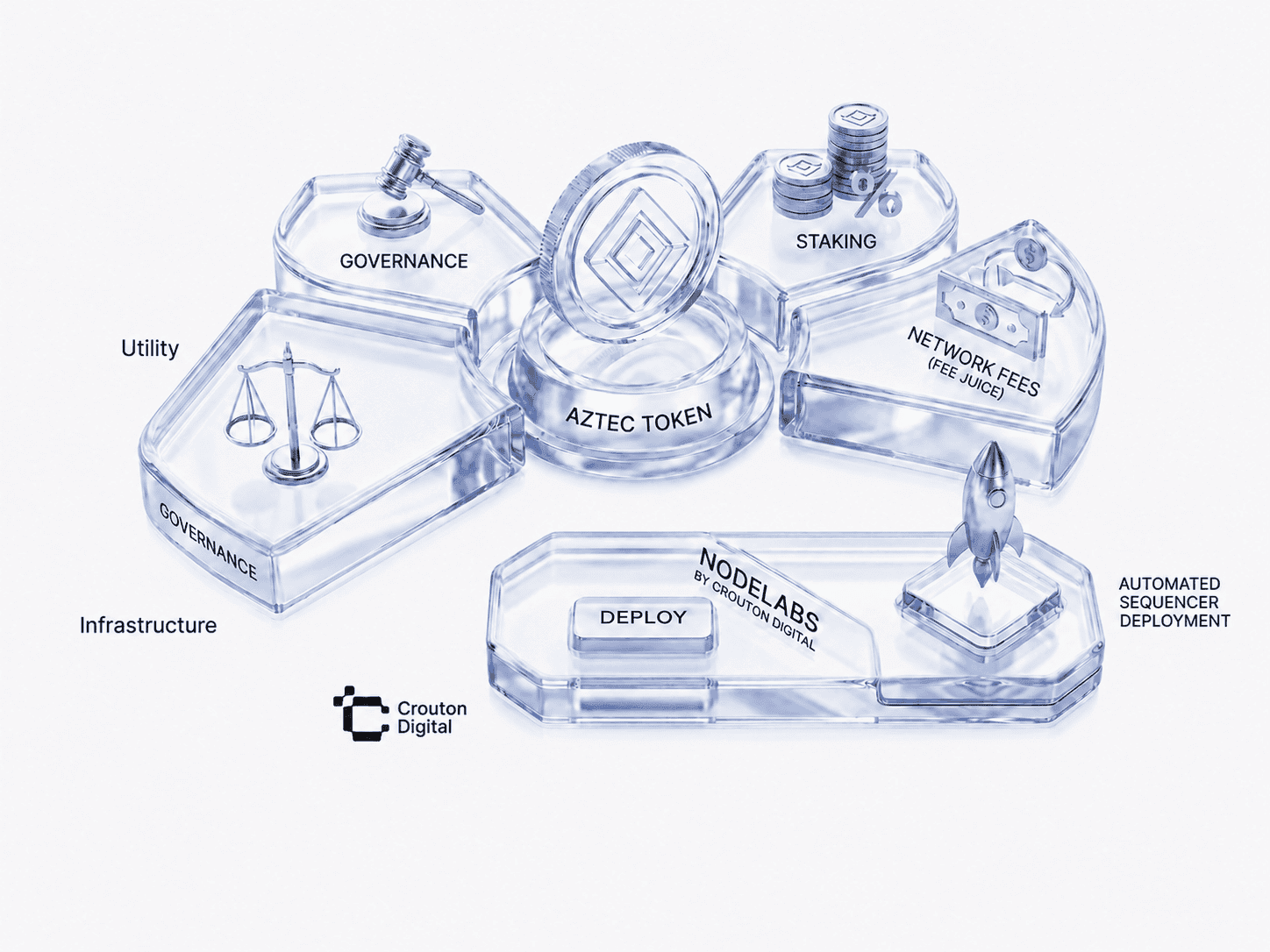
AZTEC token utility:
- Network fees for private transactions inside Aztec rollup are paid with Fee Juice, a non-transferable fee asset backed by bridged AZTEC tokens from Ethereum.
- Sequencer staking – a minimum of 200,000 AZTEC is required to participate as a sequencer and earn network rewards.
- Governance voting – token holders can stake, delegate, and participate in decisions on protocol upgrades and network parameters.
- Prover infrastructure – provers generate ZK proofs for transaction correctness and rollup finalization.
Aztec network tokenomics: the total genesis supply is 10.35 billion AZTEC. The reported allocation is:
| Allocation | Share |
|---|---|
| Investors and early supporters | 27.26% |
| Core team | 21.06% |
| Foundation | 11.71% |
| Ecosystem grants | 10.73% |
| Phase 2 public auction | 14.95% |
| Phase 1 genesis sequencer sale | 1.93% |
| Bilateral sale | 2.44% |
| Uniswap V4 liquidity pool | 2.64% |
| Future incentives | 4.89% |
| Y1 network rewards | 2.41% |
ETH remains relevant for L1 gas costs paid by operators and publishers, including bridging, publishing, and proof submission operations.
Aztec Network Official Website – Documentation and Resources
The Aztec Network official website aztec.network is the main hub for official documentation, developer resources, Alpha Network information, sequencer guides, prover guides, whitepapers, GitHub links, and community channels. The Alpha Network can be explored through the official documentation and ecosystem applications listed on the Aztec website.
Resources available on the official website include:
- Whitepaper and technical documentation
- Alpha Network access and wallet connection
- Sequencer registration and hardware requirements
- Prover operator guides and node software setup
- Links to GitHub and community channels
The official website also provides information about governance, staking, and network participation. Infrastructure providers and node operators can use the Aztec documentation to set up and manage sequencers, provers, and other network infrastructure.
Aztec Network Roles – Full Nodes, Sequencers, Provers
Roles in Aztec Network
| Role | Main function | Hardware requirements | Reward source |
|---|---|---|---|
| Full node | Stores and validates network state | 8 core / 16 vCPU, 16 GB RAM, 1 TB NVMe SSD, 25 Mbps | No direct rewards |
| Sequencer | Orders txs and produces blocks | Same hardware + 200k AZTEC stake | 70% checkpoint rewards + fees |
| Prover | Generates ZK proofs | High-performance prover setup | 30% checkpoint rewards + fees |
How sequencers work in Aztec:
Sequencers collect pending transactions from the network, order them into blocks, and propose those blocks to an attestation committee. Committee members validate the proposed block, verify transactions, and sign attestations if the block is valid. A block needs attestations from at least two-thirds plus one of the committee before it can be considered valid and submitted to L1.
Provers work alongside sequencers by generating validity proofs for completed epochs. These proofs are submitted to Ethereum and allow Aztec blocks to be finalized as part of the rollup settlement process.
Crouton Digital operates Aztec network infrastructure, including a sequencer node, supporting network liveness and decentralization.
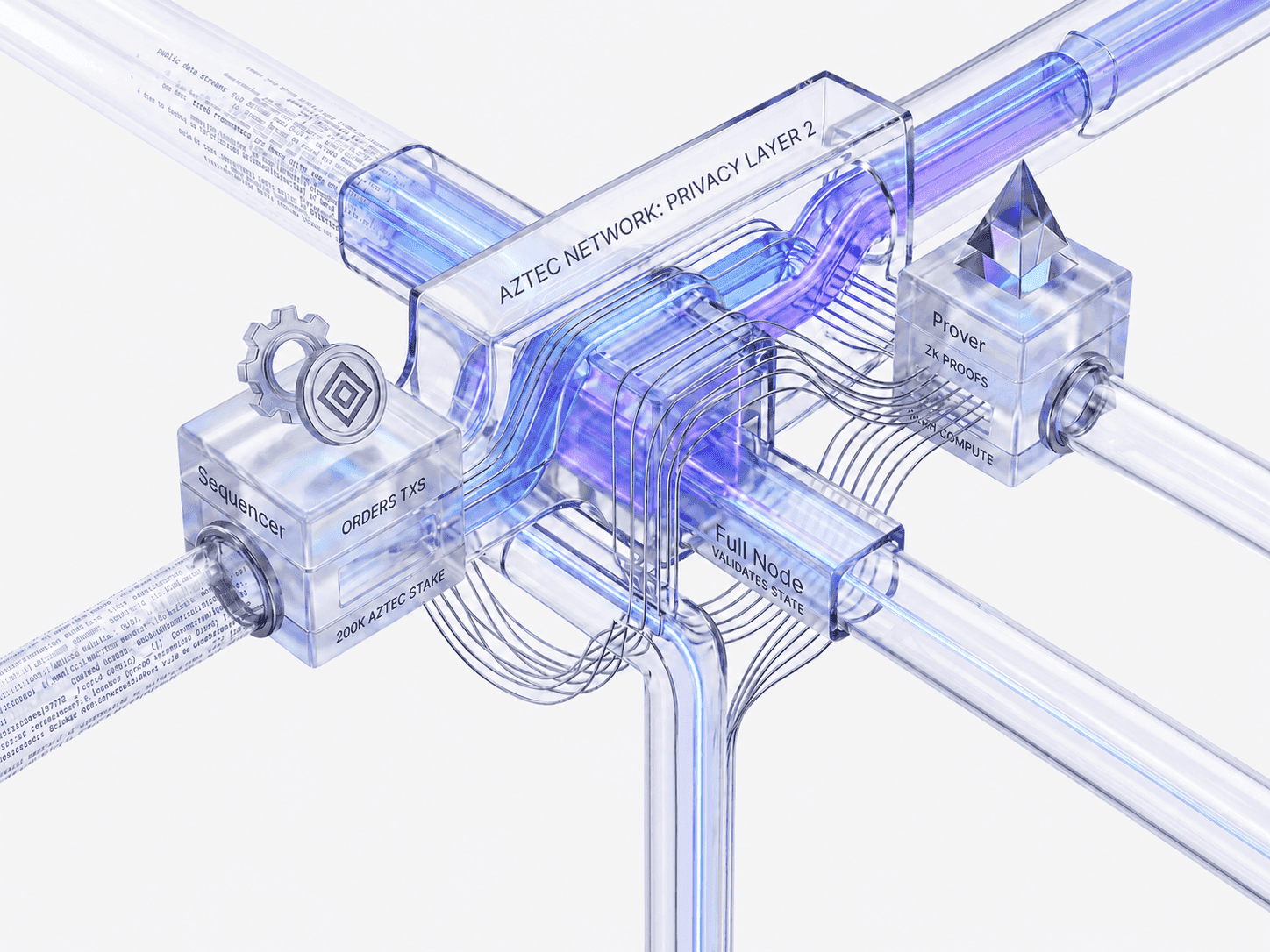
Full node vs sequencer vs prover – what's the difference:
- Full nodes help users connect to the network, submit transactions, validate proofs, and maintain network state.
- Sequencers are responsible for block production and consensus participation, and they must stake 200,000 AZTEC.
- Provers generate cryptographic validity proofs and require significantly more powerful infrastructure than standard full nodes or sequencers.
Aztec Network Privacy Rollup Ethereum – Privacy by Design
Public Ethereum vs Aztec private transaction
| Feature | Public Ethereum (L1) | Aztec Network (private L2) |
|---|---|---|
| Sender address | Public | Hidden in private txs |
| Receiver address | Public | Hidden in private txs |
| Transaction amount | Public | Hidden in private txs |
| Smart contract interaction | Public | Private or public |
| Gas paid in | ETH | Fee Juice / AZTEC |
| Privacy level | Public by default | Cryptographic privacy |
Why the community should watch Aztec:
Privacy is essential for DeFi, payments, and institutional finance because public blockchains expose transaction data by default. Aztec is a privacy-first Layer 2 zkRollup on Ethereum that brings confidential transactions, private state, and private/public smart contract execution to the Ethereum ecosystem. With active network development, token economics, and operators like Crouton Digital, Aztec is one of the leading privacy-focused L2 projects.
Crouton Digital as an Aztec Sequencer Operator
Crouton Digital currently operates an Aztec sequencer, meeting the 200,000 AZTEC stake requirement and participating in block attestations. Additionally, Crouton Digital is building Nodelabs – a platform that will soon allow anyone, even without technical skills, to deploy their own Aztec sequencer automatically. Nodelabs will handle infrastructure, updates, and monitoring. Stay tuned for announcements.
Conclusion
Aztec Network brings essential privacy to Ethereum. We have covered what Aztec is, how it solves transparency issues, its ecosystem, key participants (full nodes, sequencers, provers), sequencer mechanics (200,000 AZTEC stake, attestations, committee validation), role differences, Crouton Digital's involvement, and why the community should follow Aztec. With Crouton Digital building Nodelabs, anyone will soon be able to launch a sequencer effortlessly. Follow aztec network news and explore the already‑trading AZTEC token.
Frequently Asked Questions

A Web3 OG who has navigated the industry’s evolution from whitepapers to widespread adoption. Having built through the euphoria of bull runs and the discipline of bear winters. Opinions are strictly personal, crafted from years of deep-dive research and hands-on experience in the trenches.