


Canton Network Mainnet Validator Infrastructure by Crouton Digital

Canton Network is a decentralized blockchain designed for institutional asset tokenization. Companies can join the network and run their own validators; however, they do not have to do it alone. Crouton Digital operates a Canton Network validator, publicly visible as CroutonDigital-validator-1 in Lighthouse Explorer, and provides hosted validator infrastructure for corporate clients. This article covers the key aspects of Canton Network, the options for launching a validator, and the benefits of partnering with an experienced operator.
What is Canton Network?
Canton Network is a privacy-enabled public blockchain network designed for institutional finance and real-world asset tokenization. Unlike many public blockchains, Canton allows participants to transact and synchronize assets without exposing sensitive business data to the entire network. This makes it suitable for banks, asset managers, custodians, fintech companies, and enterprises that need both blockchain interoperability and transaction-level privacy.
A validator in Canton Network provides the infrastructure layer that allows parties and applications to connect to the network, submit transactions, maintain liveness, and interact with Canton applications. For a company, running or accessing a validator means having a controlled operational gateway into the Canton ecosystem.
A validator can support client-party onboarding, Party ID creation, transaction submission, monitoring, and operational maintenance. Depending on the setup, the validator may be operated in-house or through an infrastructure partner such as Crouton Digital.
In Canton, a Party ID represents an on-ledger identity. Through validator infrastructure, a company can onboard parties and interact with Canton applications under its own identity.
Canton Network News – Latest Ecosystem Updates
Canton Network developers regularly release updates and announcements. Canton network news today reports on new validators, protocol versions, and integrations. Canton Network continues to expand its ecosystem of NaaS providers as institutional adoption grows. Quote from an official document: "The mainnet is now live, operating in its invite‑only phase". This means that new nodes must be approved by existing participants or the Canton Foundation, ensuring a high level of security.
Native Utility Assets – Canton Coin
Canton Network uses a single native utility asset — Canton Coin (CC). The canton network coin serves as a reward token for validators and super validators who help maintain network liveness and synchronise transactions. At the same time, canton network token (the same CC token) is used to pay transaction fees on the Global Synchronizer layer and support the network's burn‑and‑mint equilibrium model.
Canton network coin price may be influenced by real network activity, institutional usage, liquidity, market conditions, and overall demand for CC. Canton network tokenomics is designed around Proof of Utility: there was no pre‑mine or pre‑sale; all CC tokens are earned by contributing value to the network — for example, by running a validator, operating an application, or generating on‑chain activity.
"Validators are eligible to mint validator liveness rewards in the form of Canton Coin" — Canton Network documentation
As more businesses join the Canton ecosystem, demand for CC may grow. Running a validator becomes not only a technical contribution but also a potential source of long‑term value aligned with the network's real‑world use.
Canton Network Blockchain – Technological Features
The Canton blockchain is built around Daml, an enterprise‑grade open‑source smart contract language that defines which parties are entitled to see and authorized to change any given contract. The protocol enforces these visibility rules across participant nodes, which are operated by individual organizations and host multiple parties on the ledger.
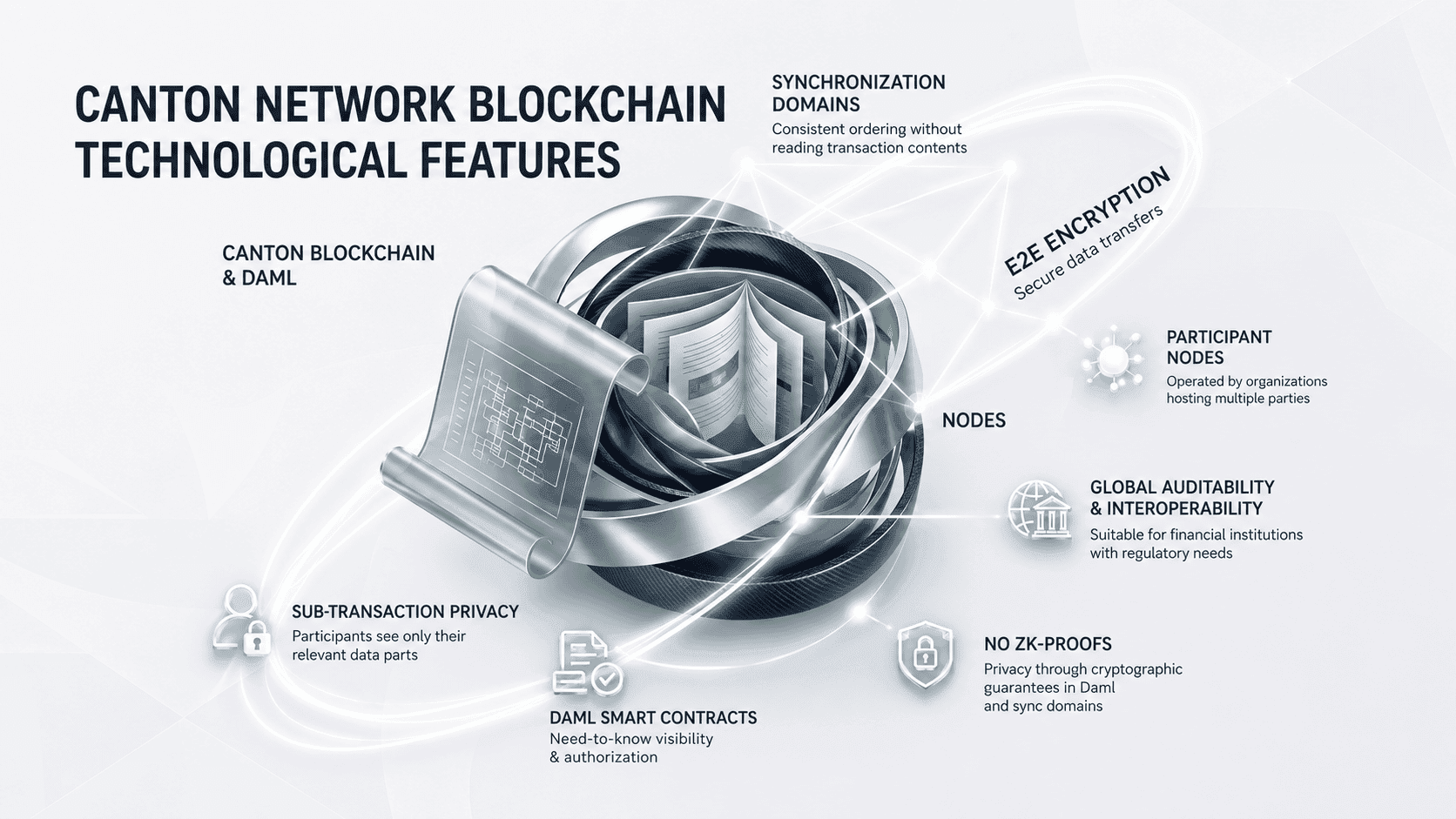
Participant nodes communicate through synchronization domains that provide consistent transaction ordering without learning the transaction contents — all data transferred between nodes is end‑to‑end encrypted and selectively shared on a strict need‑to‑know basis. Unlike traditional blockchains, Canton does not broadcast transaction details to all validators; information is visible only to those participant nodes that have explicit permission to see it.
Canton network blockchain overview 2026 highlights how this architecture delivers sub‑transaction privacy, meaning each participant sees only the part of a transaction that applies to them. Canton network blockchain privacy is achieved not through zero‑knowledge proofs, but through cryptographic guarantees built into Daml and the sync domain design. The network is suitable for financial institutions that require strong privacy while maintaining global interoperability and auditability.
Canton Crypto – Prospects of the Network's Cryptocurrency
Canton Coin and the Canton ecosystem are gaining attention from institutional players. Some analysts attempt to make canton crypto price prediction based on adoption metrics such as the number of validators, transaction volume, and ecosystem growth. However, the price of Canton Coin (CC) depends on multiple factors: supply and demand, liquidity, real‑world network usage, market conditions, and overall sentiment — not solely on validator count.
While running a validator can generate validator rewards (CC tokens for liveness and participation), it should not be framed as a direct investment strategy for token price appreciation. Validator rewards are a form of operational income, subject to network rules, hardware costs, and market volatility. For businesses, the most reliable approach is to focus on active network participation — contributing utility, securing the network, and earning rewards — while understanding that token price fluctuations carry inherent risks.
Canton Network Partnerships
Canton Network actively attracts ecosystem participants across node infrastructure, application development, custody, and institutional financial services. The network is designed for enterprise-grade tokenisation use cases, including real-world assets such as securities, funds, and other regulated financial instruments. These use cases require stable, compliant, and highly available node operations to function reliably at institutional scale.
Canton Network has attracted participation from some of the largest names in global finance and market infrastructure. Publicly announced Canton ecosystem participants and related initiatives include Goldman Sachs, BNP Paribas, Deutsche Börse Group, Cboe Global Markets, Microsoft, Deloitte, Paxos, Moody’s, S&P Global, Broadridge, DRW, Cumberland, and SBI Digital Asset Holdings. More recently, Visa announced plans to join Canton as a Super Validator, while Digital Asset and Kinexys by J.P. Morgan announced their intent to bring JPM Coin / JPMD natively to Canton Network through a phased 2026 rollout.
These names highlight Canton’s positioning as institutional-grade infrastructure for tokenized assets, regulated digital money, and privacy-preserving settlement.
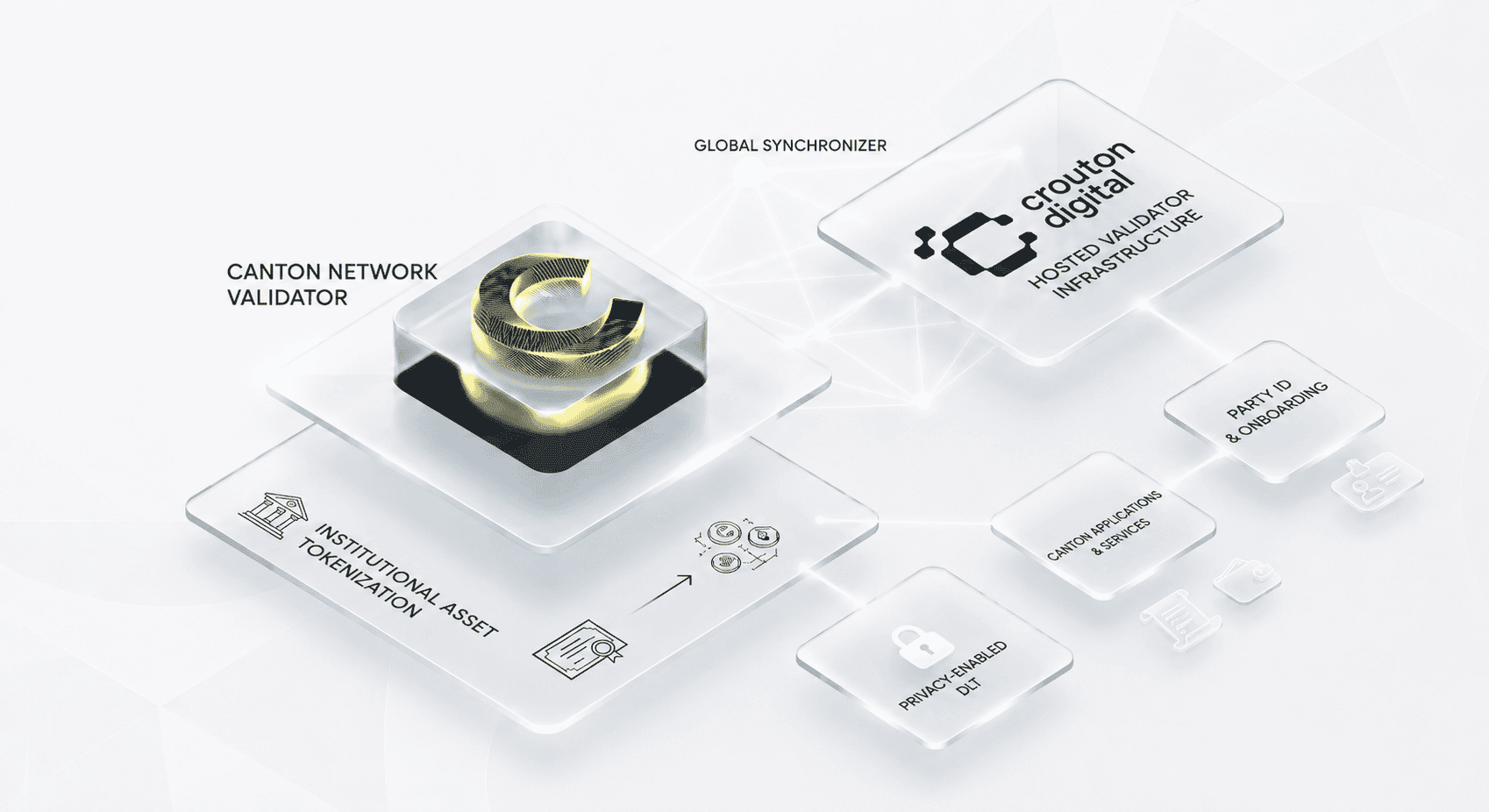
Canton's infrastructure ecosystem includes node providers, validators, application operators, custodians, and enterprise access providers. Crouton Digital participates as a Canton Network validator operator and provides hosted validator infrastructure support for corporate clients that want to access the ecosystem without building the full operational stack in-house.
Why Choose Crouton Digital for Canton Validator Infrastructure?
Companies that want to participate in Canton Network but lack the internal resources to operate validator infrastructure can work with an experienced infrastructure partner. Crouton Digital operates a Canton Network validator and can support corporate clients with hosted validator operations, Party ID creation, client-party onboarding, monitoring, updates, and operational maintenance.
Benefits of working with Crouton Digital:
- Ready-to-use hosted validator infrastructure: containerisation, monitoring, updates
- Support with Canton onboarding and operational requirements
- Party ID creation and client-party onboarding through Crouton-operated validator infrastructure
- Flexible key-management models depending on client requirements
- Option to migrate toward a more self-managed setup in the future
Comparison of validator setup methods
| Setup method | Suitable for | In‑house team required | Launch time | Key control |
|---|---|---|---|---|
| Self‑hosted (on‑prem/cloud) | Organizations able to operate validator infrastructure | High: DevOps, security, monitoring | 2–4 weeks full stack | Full infrastructure control; signing depends on party setup |
| Hosted validator infrastructure via Crouton Digital | Companies that need Canton access without running the full stack internally | Low to medium; depends on custody, external signing, and operational model | Initial infrastructure can be prepared quickly; MainNet access depends on approval and onboarding | Managed infrastructure; signing control depends on internal vs external party setup |
| Application operator / managed application access | Clients of a specific dApp | None | Upon signing | Application-dependent; may be custodial or externally signed |
Steps to get started with Crouton Digital as your validator partner:
- Crouton Digital prepares the hosted validator environment and supports client-party onboarding.
- Crouton Digital creates or helps manage the client's Party ID through its Canton validator infrastructure.
- Where MainNet validator participation is required, the access process remains subject to Canton Network approval and onboarding requirements.
- Once approved and connected, the client can participate in the Canton ecosystem while Crouton Digital handles infrastructure monitoring, updates, and operational maintenance.
Conclusion
Canton Network opens the door to decentralised asset tokenisation for businesses. Running a validator does not require building everything from scratch. With Crouton Digital as your infrastructure partner, you can reduce the complexity of validator deployment, onboard client parties, create Party IDs, and participate in the Canton ecosystem with professional infrastructure support. MainNet validator participation and reward eligibility remain subject to Canton Network approval, correct configuration, and ongoing network requirements.
Frequently Asked Questions

A Web3 OG who has navigated the industry’s evolution from whitepapers to widespread adoption. Having built through the euphoria of bull runs and the discipline of bear winters. Opinions are strictly personal, crafted from years of deep-dive research and hands-on experience in the trenches.