


GenLayer – What Is the AI-Native Blockchain and Why Does It Matter for Web3?

GenLayer Crypto – What Is It and Why Does It Exist?
Traditional blockchains are excellent at deterministic execution: given the same input, they always produce the same output. But they are isolated from the outside world, cannot understand natural language, and rely on oracles to bring in external data – introducing centralization risks.
GenLayer crypto was built to solve this. It is a decentralized network where independent AI models reason on their own, then reach agreement on questions that have no single deterministic answer, producing one trustworthy outcome the whole network can rely on.
GenLayer exists because traditional smart contracts are static. They always give you the same output for the same input.
GenLayer funding reached $7.5 million in a seed round led by North Island Ventures, with participation from Node Capital, Arrington Capital, ZK Ventures, and industry veterans including Arthur Hayes's family office. This funding supports the development of the first Intelligent Blockchain – a network where AI is embedded not just in applications but in the consensus layer itself.
For a comprehensive genlayer crypto project overview, it helps to understand that GenLayer is not a traditional Layer 1 or Layer 2 – it is a new category of blockchain that treats AI as a first‑class citizen in its consensus and execution layers.
Intelligent Contracts – What Makes Them Different
The core innovation of GenLayer is Intelligent Contracts. Unlike traditional smart contracts that execute rigid, deterministic code, Intelligent Contracts are Python programs that can read the web, interpret natural language, and handle non-deterministic operations.
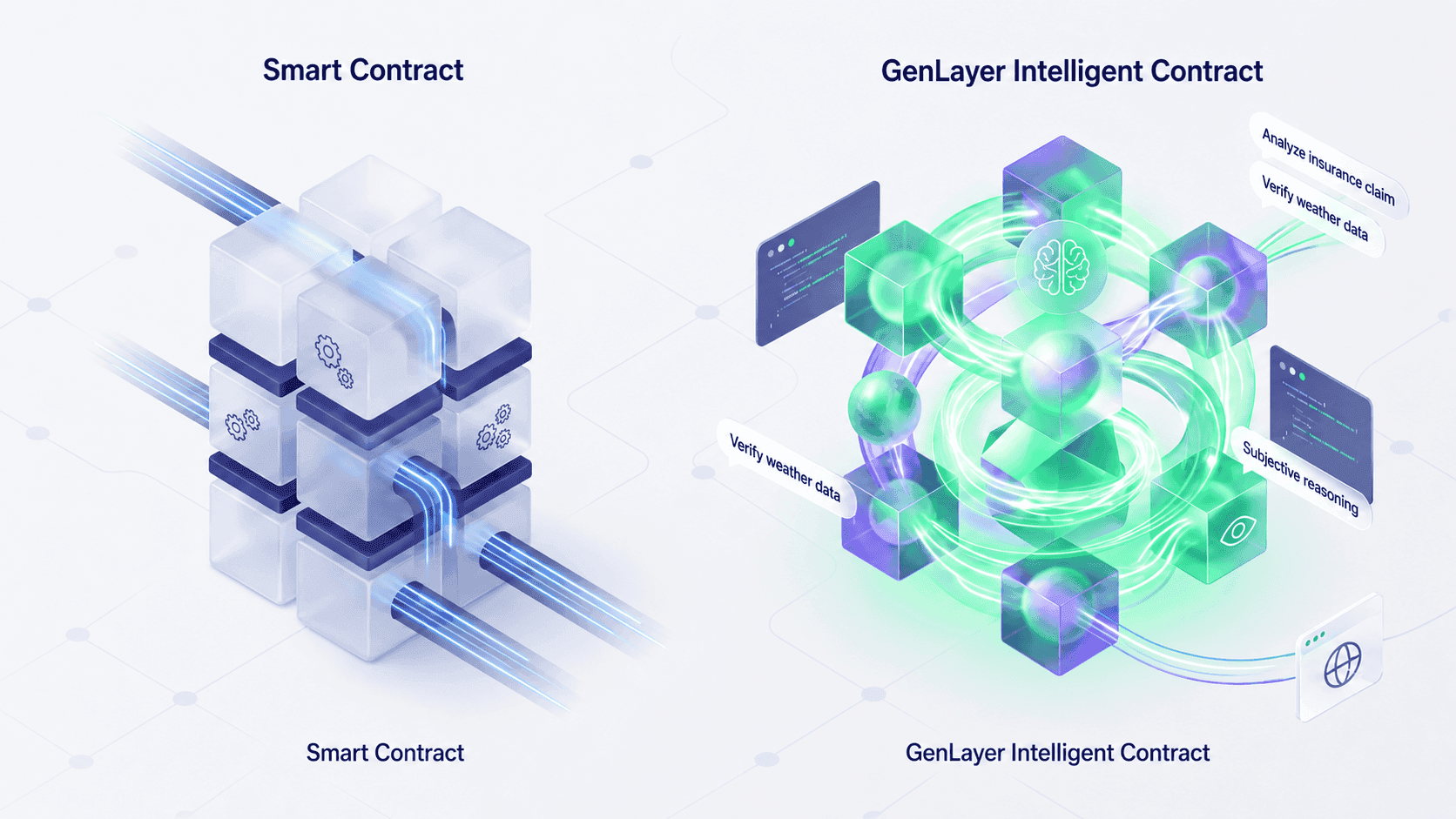
| Feature | Traditional Smart Contracts | GenLayer Intelligent Contracts |
|---|---|---|
| Input type | Deterministic (code only) | Non-deterministic (natural language, web data) |
| Internet access | No (isolated) | Yes (can browse and reason) |
| Decision-making | Fixed logic | AI-powered reasoning |
| Flexibility | Rigid, cannot adapt | Can adapt to new information |
| Real-world data | Via oracles (centralized risk) | Direct web access + validator consensus |
Intelligent Contracts can handle non-deterministic inputs. They can adapt to changes, making them far more flexible and powerful than classic smart contracts.
For example, an Intelligent Contract on GenLayer could resolve an insurance claim by checking real-world news sources, verifying whether a flight was "significantly delayed," or determining if a property was affected by a flood – all through validator consensus on subjective questions. This is how genlayer ai smart contracts work in practice, combining blockchain security with AI reasoning.
GenLayer Blockchain – How Optimistic Democracy, GenVM, and Validators Work
GenLayer achieves consensus on subjective tasks through a unique mechanism called Optimistic Democracy – an enhanced Delegated Proof-of-Stake (dPoS) consensus model where validators connect directly to Large Language Models (LLMs). This is the foundation of genlayer ai blockchain architecture.
GenVM – The Execution Environment for Intelligent Contracts
GenVM is the execution environment for Intelligent Contracts in the GenLayer protocol. It is a WASM-based virtual machine designed specifically to execute Intelligent Contracts, handling non-deterministic operations that traditional VMs cannot process.
Each validator node is powered by a GenVM: a sandboxed environment that executes the contracts and safely handles their non-deterministic calls to the web and to LLMs. GenVM seamlessly merges standard on-chain execution with the power of AI – opening up entirely new use cases unthinkable on traditional blockchains. This is the core of genlayer crypto or blockchain technology – a blockchain that can reason.
How GenLayer Works with AI, External Data, and Non-Deterministic Decisions
This convergence of blockchain and artificial intelligence is at the core of genlayer crypto ai, making it possible to build applications that reason and adapt in real time. GenLayer enables Intelligent Contracts to work with AI, external data, and non-deterministic decisions through several key mechanisms:
- Non-deterministic operations – Intelligent Contracts can perform operations whose results can vary between nodes, such as external API calls, LLM and AI model calls, random number generation, or other variable execution.
- Web access – Intelligent Contracts can fetch external data, send HTTP requests, render web pages, and capture screenshots. The GenVM requires these operations to run inside non-deterministic blocks so validators can reach consensus.
- The Equivalence Principle – Since LLM responses and web data vary across validators, GenLayer lets you define how validators compare results to reach consensus. Validators independently execute and then agree on equivalence of outcomes under shared rules.
Optimistic Democracy resolves these non-deterministic outcomes through a multi-validator consensus process. For a complete genlayer crypto overview, understanding this AI-consensus integration is essential.
Optimistic Democracy – Consensus for the Unpredictable
Optimistic Democracy is GenLayer's consensus method for validating transactions and operations of Intelligent Contracts. The process works as follows:
- A user submits a transaction to the network.
- A randomly selected lead validator proposes a result, using their connected LLM to reason about the request.
- Other validators independently verify the proposal using their own AI models.
- If a majority agrees on the outcome, the transaction is executed.
- If the validator set cannot reach consensus, a new leader is chosen.
- An appeal window allows participants to post a bond and double the validator set for a re-evaluation.
Validators are selected via a weighted random selection based on total stake, ensuring fairness and proportional representation.
Validators are essential participants in the GenLayer network. They are responsible for validating transactions and maintaining the integrity and security of the blockchain. Key responsibilities include running a validator node with a connected LLM, participating in Optimistic Democracy consensus, proposing and voting on transaction outcomes, maintaining high uptime to earn rewards, and configuring and fine-tuning their AI models for optimal performance. Validators receive a 10% operational fee from rewards before distribution. To become a validator, participants must stake GEN tokens on the rollup layer. In the initial epoch 0, the normal staking rules are relaxed to allow rapid network bootstrapping. Token distribution details, including any potential genlayer airdrop for early participants, are expected to be announced closer to mainnet.
GenLayer Funding and the Road to Mainnet – Asimov, Bradbury, and Clarke
GenLayer is progressing through a structured, multi-stage testnet program designed to validate the network's novel Optimistic Democracy consensus mechanism. For those wondering genlayer blockchain in its current state, it is a network in active testnet development.
"The GenLayer testnet campaign is structured as a two-stage rollout: Asimov tests core network mechanics and validator onboarding. Bradbury shifts focus to validator-specific AI operations and real-world data interpretation."
Testnet Asimov – Laying the Foundations
Asimov was the first of two pre-mainnet testnets, launching in June 2025. During this phase, GenLayer focused on testing core network mechanics and validator onboarding, providing subsidized LLM access to stress-test transaction execution and consensus pathways, validating the Optimistic Democracy consensus mechanism, and building the developer ecosystem with GenLayer Studio, Explorer, Wallet, and genlayer-js library. Asimov featured a transparent and incentivized point system that rewarded validators for active participation across network operations, testing activities, and ecosystem contributions. This is where the genlayer crypto project first demonstrated its viability.
Testnet Bradbury – Where AI Meets Blockchain Consensus
Bradbury went live in early 2026 as GenLayer's second major testnet milestone. If Asimov built the plumbing, Bradbury introduces the final ingredient: LLM inference and validator autonomy – validators select and fine-tune their preferred LLMs, optimizing for inference quality and performance.
What's new in Bradbury Phase 2: Bradbury Phase 2 is a separate milestone with a testnet reset. This reset clears the existing network state – including accounts, transactions, and validators – to provide a fresh testing environment for new features. It allows the team to test token distribution processes and epoch 0 bootstrapping procedures from a clean slate.
Key features of Bradbury:
- Validator autonomy – operators select and fine-tune their preferred LLMs
- Model routing – validators can use different LLMs for different contracts
- Greyboxing experimentation – applying transformations before LLM calls to improve performance and security
- Bradbury is not designed for production apps – it is a research environment where experiments coexist and history resets periodically
Testnet Clarke – The Final Stop Before Mainnet
Clarke is the upcoming testnet phase – the final stop before mainnet. According to the GenLayer roadmap, Clarke represents a significant milestone where validator operations become more automated and critical for the network's future.
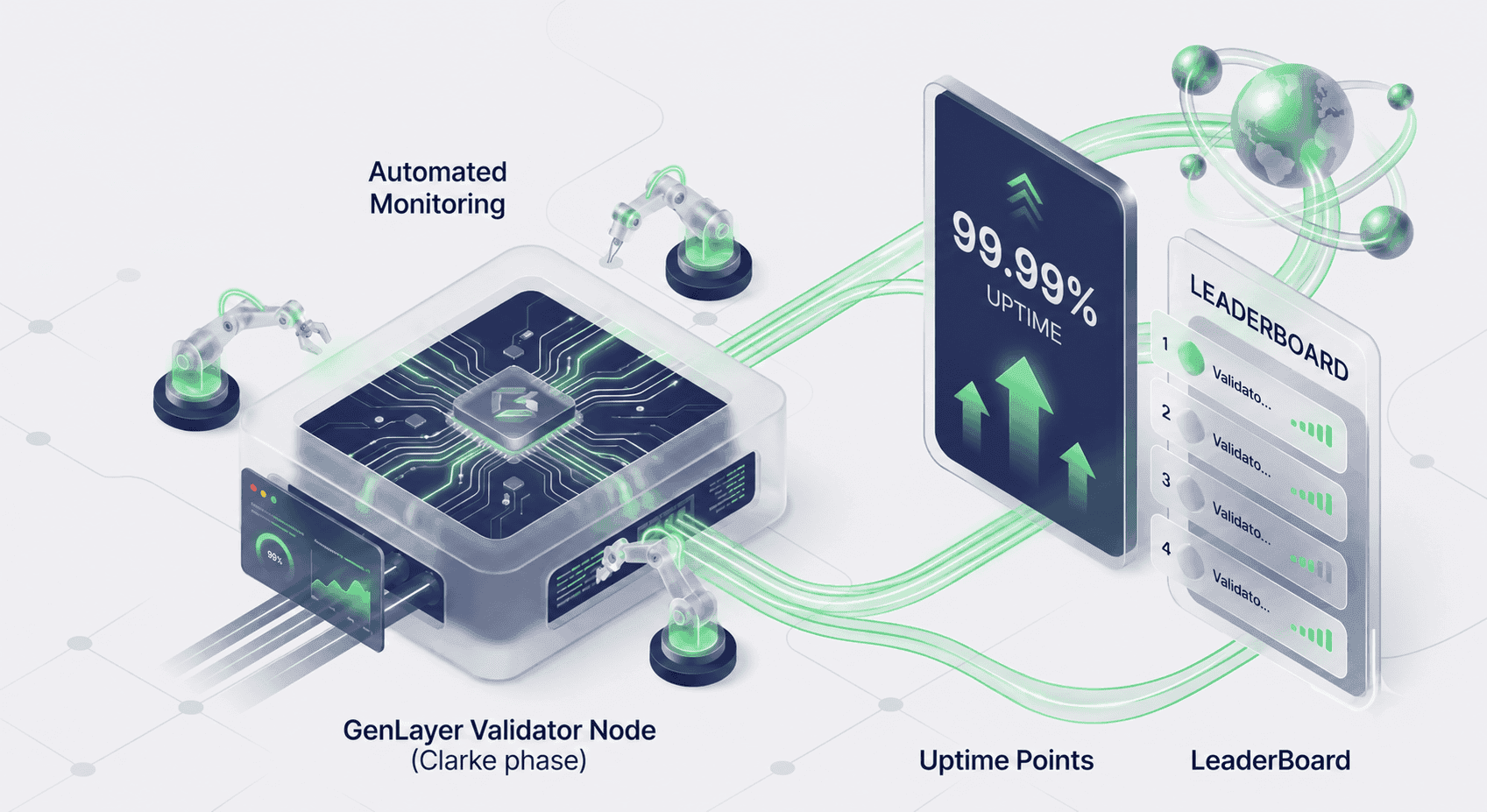
What changes for validators in Clarke:
- Automated monitoring: The network will automatically monitor node status and send notifications about issues
- Uptime points: Validators earn uptime points for maintaining stable node operations
- Leaderboard: A public leaderboard will track validator performance based on uptime and responsiveness
- Future delegation: Token delegation will depend on validator positions in the leaderboard, making stable node operation and quick reaction to problems especially important
- Parallel operation: Bradbury Phase 2 and Clarke will operate in parallel until mainnet launch
Upcoming milestones before Clarke:
- Completion of Asimov
- Launch of Bradbury Phase 2 with a testnet reset (separate from the current Bradbury phase)
- Testing of token distribution processes
- Testing of epoch 0 bootstrapping procedures
"Epoch 0 is the genesis bootstrapping period with special rules designed to facilitate network launch. The normal staking rules are relaxed to allow rapid network bootstrapping."
Why Uptime, Infrastructure, and Validator Operations Matter for GenLayer
With Clarke approaching, the importance of reliable validator infrastructure cannot be overstated. Validators run the consensus infrastructure and are responsible for executing intelligent contracts and validating transactions. Their role is crucial for ensuring the network's reliability and achieving consensus on transaction outcomes. This is where rallyonchain genlayer and similar applications will depend on stable validator performance.
As the network approaches mainnet, validator performance metrics like uptime will have a direct impact on future rewards.
Uptime Points, Leaderboard, and Validator Readiness
In Clarke, uptime points will become a key metric for validators, reflecting node availability, quick response to network issues, consistent participation in consensus, and overall reliability. The leaderboard will rank validators based on these metrics, and future token delegation will depend on validator positions in the leaderboard – higher uptime scores attract more delegations and higher rewards.
For validators preparing for Clarke and mainnet, the key priorities are infrastructure stability (24/7 node uptime with professional-grade infrastructure), monitoring and alerting (automated systems to detect and resolve issues quickly), model optimization (fine-tuning LLM selection and configuration), security hardening (protection against prompt injection and adversarial attacks), and team readiness (operational staff available around the clock).
"In Clarke, future token delegation will depend on validator positions in the leaderboard. Therefore, stable node operation, uptime, and fast reaction to problems become especially important."
GenLayer vs 0G Labs – How They Differ and Why Crouton Digital Is Involved
Crouton Digital is an institutional-grade blockchain infrastructure provider that operates reliable validator and node infrastructure across 45+ networks. The company actively participates in early-stage and invited validator alignment programs for next-generation protocols. For those interested in genlayer crypto analysis, the involvement of established infrastructure providers like Crouton Digital signals strong institutional interest.
As a validator for GenLayer, Crouton Digital brings:
- Professional validator experience across multiple PoS networks including Cosmos, Axelar, Celestia, Osmosis, and EigenLayer
- Enterprise-grade infrastructure with geographically distributed nodes and high availability
- A long-term commitment to crypto since 2020 with EU licensing for crypto operations
Crouton Digital's participation helps ensure the network's security and decentralization as it progresses toward mainnet. The genlayer labs team works closely with infrastructure partners to ensure robust network operations.
GenLayer represents a fundamental shift in what blockchain can do. By embedding AI into the consensus layer and enabling Intelligent Contracts that can reason, adapt, and access the internet, GenLayer opens up entirely new categories of applications: autonomous finance, prediction markets, decentralized insurance, agentic commerce, and performance-based marketing.
In the broader landscape of AI‑integrated blockchains, genlayer vs 0g labs highlights two different approaches: while 0G focuses on decentralised AI data storage and inference, GenLayer embeds AI reasoning directly into the consensus mechanism through Optimistic Democracy and Intelligent Contracts.
With strong funding, a clear roadmap, and a growing ecosystem of validators like Crouton Digital, GenLayer is positioning itself as the intelligence layer for Web3. The upcoming Clarke testnet and mainnet launch are key milestones to watch. For the latest updates, visit the genlayer official website.
Conclusion
GenLayer is building the first intelligent blockchain – a network where smart contracts become Intelligent Contracts that can think, reason, and adapt using AI. Through Optimistic Democracy consensus, GenVM execution, and a diverse set of AI-powered validators, GenLayer enables subjective decisions and real-world data integration that traditional blockchains cannot handle.
The journey to mainnet is progressing through Asimov, Bradbury (with Phase 2 planned), and the upcoming Clarke testnet – the final stop before mainnet. For validators, Clarke brings automated monitoring, uptime points, and a leaderboard that will directly influence future token delegation. Professional infrastructure providers like Crouton Digital are already participating as validators, supporting the network through its testnet phases.
GenLayer is not just another blockchain – it is a new paradigm for decentralized trust in the AI age.
Frequently Asked Questions

A Web3 OG who has navigated the industry’s evolution from whitepapers to widespread adoption. Having built through the euphoria of bull runs and the discipline of bear winters. Opinions are strictly personal, crafted from years of deep-dive research and hands-on experience in the trenches.