

Somnia Network: How SOMI, STT, and Real-Time Infrastructure Could Shape the Future of the Metaverse

Metaverse sounds like a word from the future. And if you’ve ever looked into this topic, you’ve probably noticed there were many projects-and even more ideas. The truth is, not everyone managed to turn what they envisioned into a convenient product you actually want to come back to: sometimes technical limitations got in the way, sometimes there wasn’t enough content or enough people.
Somnia Network emerged at a time when the market especially needs practical solutions. It draws attention not through loud claims, but through its approach: making virtual worlds and applications run as smoothly and familiarly as websites, games, or social networks - without extra delays, complicated steps, or noticeable fees. Below is an informative but easy-to-read article about Somnia Network - what the project is, why it’s needed, how it differs from other blockchains, who supports it, how tokens and staking work-and why Somnia is genuinely interesting to follow. Inside, we’ll break down:
- why most metaverses never became mainstream
- what Somnia Network is and its core idea (speed, fees, real-time)
- why it matters that Somnia is already live on mainnet, and what testnet is for
- what opportunities exist for users and creators (worlds, avatars, digital goods)
- how SOMI and staking work-and how to get STT test tokens to try the network
Somnia Network and why most “metaverses” failed
The metaverse idea itself is genuinely great. These are digital worlds where you can communicate, create things, own them, sell them, and move them between different apps. It feels like it could be the next step for the internet.
But in practice, many projects lacked strong execution.
First, things often worked slowly. You enter a world and it lags. You do something simple and you have to wait. You try to buy or swap something, and the process drags across several steps. The feeling of ease disappears.
Second, fees got in the way. In a game or virtual world, there are lots of actions: movement, purchases, upgrades, swaps, rewards. When each action requires a noticeable payment, using the product becomes uncomfortable.
Another issue is the boundaries between projects. You bought a skin or an item, but it only works in one app. You created something cool, but it’s permanently tied to a single platform. Moving to another world with your character or inventory often just isn’t possible.
And finally, many worlds lacked life. Even with beautiful visuals, if there’s no content and no clear economy, the desire to return fades quickly.
Somnia Network is built around a simple idea: the metaverse will become mainstream when the infrastructure is fast and accessible, and digital assets truly belong to users.
Somnia Network overview and real-time metaverse infrastructure
Somnia is a Layer 1 blockchain, meaning a base network like Ethereum or Solana. It was designed from the start for applications where everything must work in real time: games, social platforms, interactive worlds, marketplaces, and online events.
Somnia’s main focus is speed and usability. The team talks about throughput of over 1,000,000 transactions per second, near-instant confirmations, and fees under one cent.
Put simply, Somnia Network wants blockchain actions to feel as easy as regular actions inside a familiar app. You press a button-and it happens immediately.
Somnia mainnet launch and the role of SOMI
The good news is that Somnia has already launched its main network. Somnia mainnet and the SOMI token were officially launched on September 2, 2025. That means the project has moved from demos and tests into full operation in real conditions.
At the same time, the testnet hasn’t gone anywhere. It’s still available as a convenient environment where you can safely experiment, learn, and test applications without risking real funds.
High performance architecture of Somnia Network
To understand why Somnia emphasizes performance, let’s compare two familiar scenarios.
-
In a typical blockchain, you don’t make transfers or NFT purchases that often. Waiting 10-60 seconds usually isn’t critical.
-
In a game or metaverse, everything is different. There are many actions-sometimes dozens per minute. If every movement, purchase, or interaction comes with a delay, interest disappears fast.
Somnia is trying to make sure the blockchain doesn’t distract from the experience-so you think about the world, the game, and events, not about fees and confirmation times. That is one of the main ideas behind Somnia Network infrastructure.
Somnia Network use cases: virtual Worlds, applications, and digital assets
-
Creating virtual Worlds on Somnia Network In Somnia, you can assemble your own locations and ideas in a clear format. It can be a cozy café, a gallery, a community hub, a mini-game, or even a small educational project. Tools like World Builder help create environments without complex development.
-
Interactive experiences in Somnia Virtual worlds become interesting when something is always happening. In Somnia, you can attend events, complete quests, earn rewards, meet people, and simply explore new spaces.
-
Digital asset economy in Somnia Network You can make items for avatars and worlds-clothing, accessories, emotes, skins, décor, or event tickets. These can be issued as digital assets and transferred or sold to other users.
-
Launch projects and find your audience If you’re a developer or a team, you can launch games, apps, and community services on Somnia Network. If you’re not a developer, you can still participate-create content, support projects, and be part of the economy.
-
The key principle everything relies on On traditional platforms, a lot depends on the rules of a single company. In Somnia’s blockchain approach, digital items and assets are tied to your wallet. This gives more control and makes items more portable across different apps inside the ecosystem.
A simple example
Let’s say you’re a 3D artist and you made a great item-like a helmet, sword, jacket, or an interior statue.
In typical Web2 platforms, you upload your work into one service and from there a lot depends on that platform’s rules. Sales usually go through the marketplace, and using the item in other projects can be difficult. Sometimes there are also questions about who owns the rights and what you’re allowed to do with them.
In the Web3 approach that Somnia supports, your work becomes a digital asset. You can transfer it, sell it, use it across different worlds within the ecosystem, and also grant access to content via tokens.
At first glance it sounds like a simple idea, but this is exactly what builds a clearer and fairer economy for creators inside Somnia Network.
Three key features of Somnia
Put very simply, Somnia has three key goals: compatibility with familiar tools, high speed, and stable low fees.
EVM compatibility Somnia is compatible with the EVM, meaning the Ethereum ecosystem. For developers, this is convenient because many familiar smart contracts and tools can be ported with minimal changes.
Parallel processing (multi-stream) One of Somnia’s ideas is to process many actions at the same time. This helps the network handle load better, especially as the number of users grows. It’s like replacing one long line with several lines-everything moves noticeably faster.
IceDB and more predictable fees Fees depend not only on demand, but also on how the network stores and updates data. Somnia uses its own data approach (IceDB) so network actions stay fast and fees are more stable and understandable for users.
1 Million TPS performance in Somnia Network
Somnia officially positions itself as a high-performance L1 blockchain capable of processing over 1,000,000 transactions per second and operating with sub-second finality.
In addition, Improbable-an ecosystem partner and investor-notes in an official press release that Somnia demonstrated performance of over 1 million transactions per second on its devnet.
In other words, Somnia Network is designed from the ground up for scenarios where there are many actions and everything should happen almost instantly. That’s why TPS here is not just a standalone number, but part of the network’s overall idea: mass applications and real-time operation.
Somnia Passport, avatars, and portability
In normal online services, we have a profile that the platform uses to understand who you are. In the Somnia ecosystem, that role is performed by Somnia Passport. It’s a single profile you can use across different projects in the network.
The idea is that your character and digital items aren’t tied to one specific world. Avatars, accessories, and other items can be moved between different apps and spaces if they support the format. This gives users more freedom: your character and its items aren’t locked to one place and can carry across different projects.
Put simply, Passport helps connect different worlds into one shared system. You don’t start from scratch in every new world-you continue with what you’ve already created and collected.
Who’s behind Somnia Network
Somnia is also widely discussed because notable players in the metaverse industry support it. It has been publicly reported that up to $270 million in support is allocated for ecosystem development, and there are grant programs for teams that want to build on Somnia Network.
Why this matters in simple terms:
-
Funding allows teams to work steadily on products, hire people, and develop ideas instead of surviving from release to release.
-
Strong partners usually bring more than money: they also bring experience, connections, and access to tools that speed up development.
-
A metaverse isn’t built from a single app. It’s an environment that needs many different worlds, games, services, and communities so people actually want to stay inside it.
SOMI tokenomics
Every blockchain has its main token. It’s needed for the network to function and for users to perform actions within the ecosystem.
In Somnia, that token is SOMI. It’s used for:
- paying transaction and network action fees
- staking, which helps maintain security and stable blockchain operation
- participating in the economy of apps within the ecosystem (and in the future, possibly governance mechanics if the model evolves)
SOMI limited supply
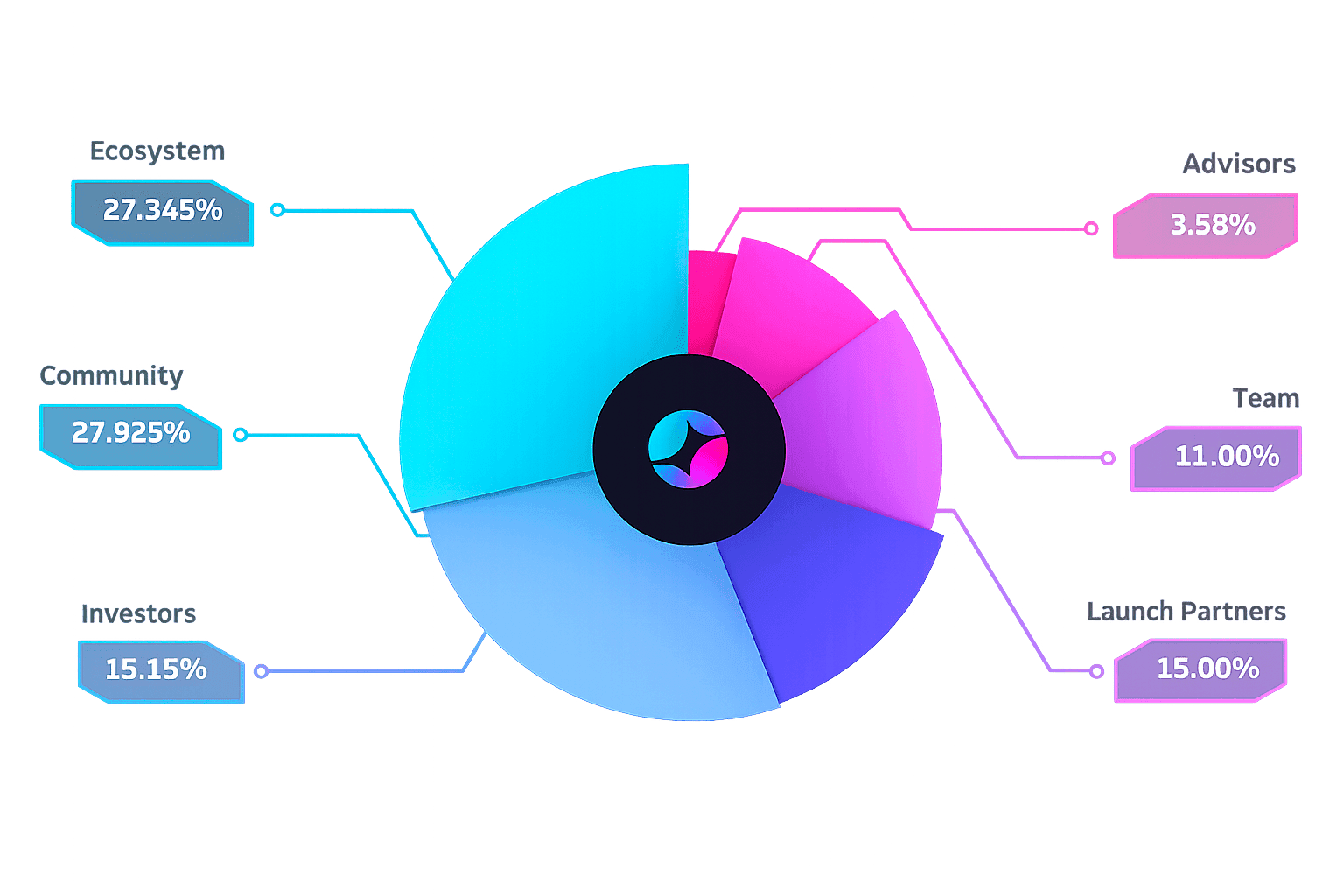
SOMI has a fixed total supply. A total of 1,000,000,000 tokens is planned. This matters because you can immediately understand the scale of supply and not worry about unlimited minting.
How SOMI tokens enter circulation
Somnia describes token issuance as a gradual process over time. The project documents mention an unlock model over 48 months. Tokens do not enter circulation all at once-they are released step by step so ecosystem development remains smoother.
At the time of the TGE, 16.02% of the total token supply entered circulation. This portion was allocated to areas related to the community and ecosystem development. In short, the unlock logic usually follows two approaches:
- tokens intended for the ecosystem unlock gradually and evenly over 48 months
- investor and advisor tokens have a 12-month cliff, then unlock in stages over roughly 36 months
What this means for a typical user: the issuance model is designed so new tokens enter the market smoothly and supply doesn’t increase in sudden jumps. For some users and market participants, SOMI price is also one of the indicators they watch alongside unlock schedules and ecosystem growth.
Staking in Somnia: how it works overall
Somnia runs on a Proof of Stake model. That means the network is secured by validators. They run and maintain nodes and stake tokens to validate transactions and keep the network stable. For correct operation, validators receive rewards. If a node performs poorly or breaks rules, the network has penalty mechanisms that can reduce the stake.
There are two main ways to participate in the ecosystem.
-
Validators These are professional teams responsible for infrastructure. They ensure uninterrupted node operation, updates, security, and monitoring. Somnia documentation states that running a validator node requires a large stake-5,000,000 SOMI. (docs.somnia.network)
-
Delegators If you don’t plan to run your own server, you can delegate your tokens to a chosen validator and receive a share of rewards. This also helps the network stay more resilient, because stake is distributed across different validators rather than concentrated in one place.
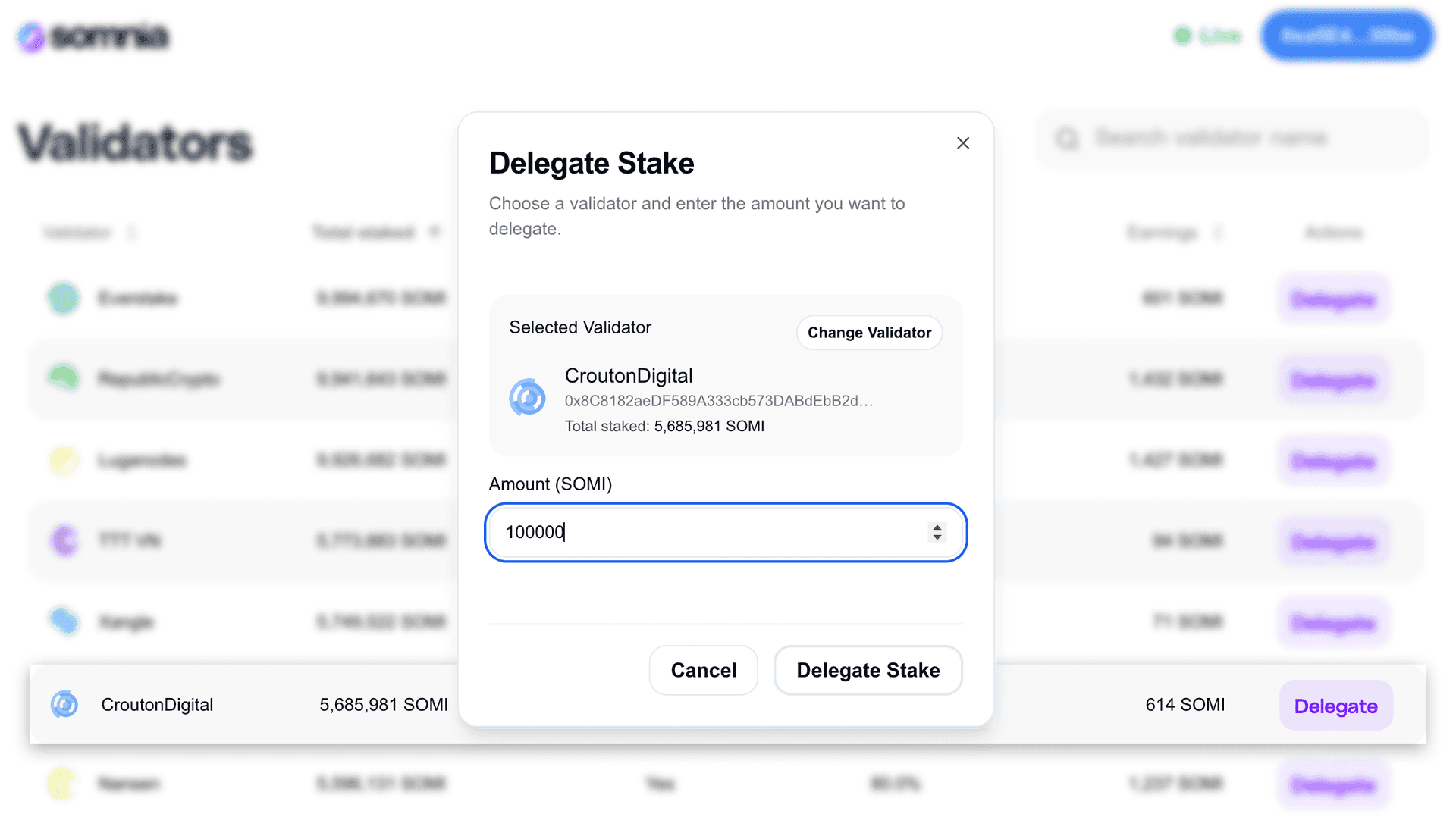
How to stake tokens with the Crouton Digital validator:
-
Find the CroutonDigital validator in the list
-
Click “Delegate”
-
Enter the number of tokens (leave a small amount for fees)
-
Click “Delegate stake”
-
You can track staked tokens in the “My Delegations” section
How Somnia differs from other L1 projects
To understand how Somnia differs from other networks, let’s compare it with a few well-known blockchains.
Ethereum
Ethereum today is a huge ecosystem with thousands of projects and a strong community. At the same time, the base layer is often expensive in fees and not always suited for scenarios that require many fast actions. That’s why games and mass applications often move to L2 solutions or choose other networks.
Somnia emphasizes that even at the base-layer level, everything should be fast and low-fee. This is especially important for interactive apps and worlds where actions happen constantly.
Solana and other fast networks
Solana and similar L1s have long focused on high speed and low fees. This helped them become strong platforms for DeFi, NFTs, and active users.
Somnia focuses on real-time applications-primarily games and interactive worlds. Its aim is to handle a huge number of small actions comfortably. This isn’t only about token swaps, but constant in-game and in-world interactions where smoothness and instant response matter.
The main difference of Somnia Network
Put simply, Somnia aims to become a foundation for Web2-level apps in terms of usability and speed, but with the ability to own digital assets and use them across different projects within the ecosystem. That positioning is one of the reasons Somnia Network stands out among newer L1 projects.
Shannon Testnet
Somnia has a test network called Shannon. It’s there so you can safely explore the ecosystem, try apps and tools, and test the network without risking real funds. The Somnia testnet page also highlights high speed, fast confirmations, and very low fees.
The basic start looks like this:
-
Open the Somnia Testnet site
-
Add the network to your wallet
-
Get test tokens (STT)
-
Create an avatar or profile
-
Explore available worlds and tools
How to get test tokens (STT)
- Open Somnia Testnet - https://testnet.somnia.network/, connect your wallet, and click Add network to add the network to your wallet.
- Go to Get STT and click Request Tokens.
- Paste your wallet address and submit the request for STT.
If needed, check that the tokens arrived via the explorer link located on the testnet portal.
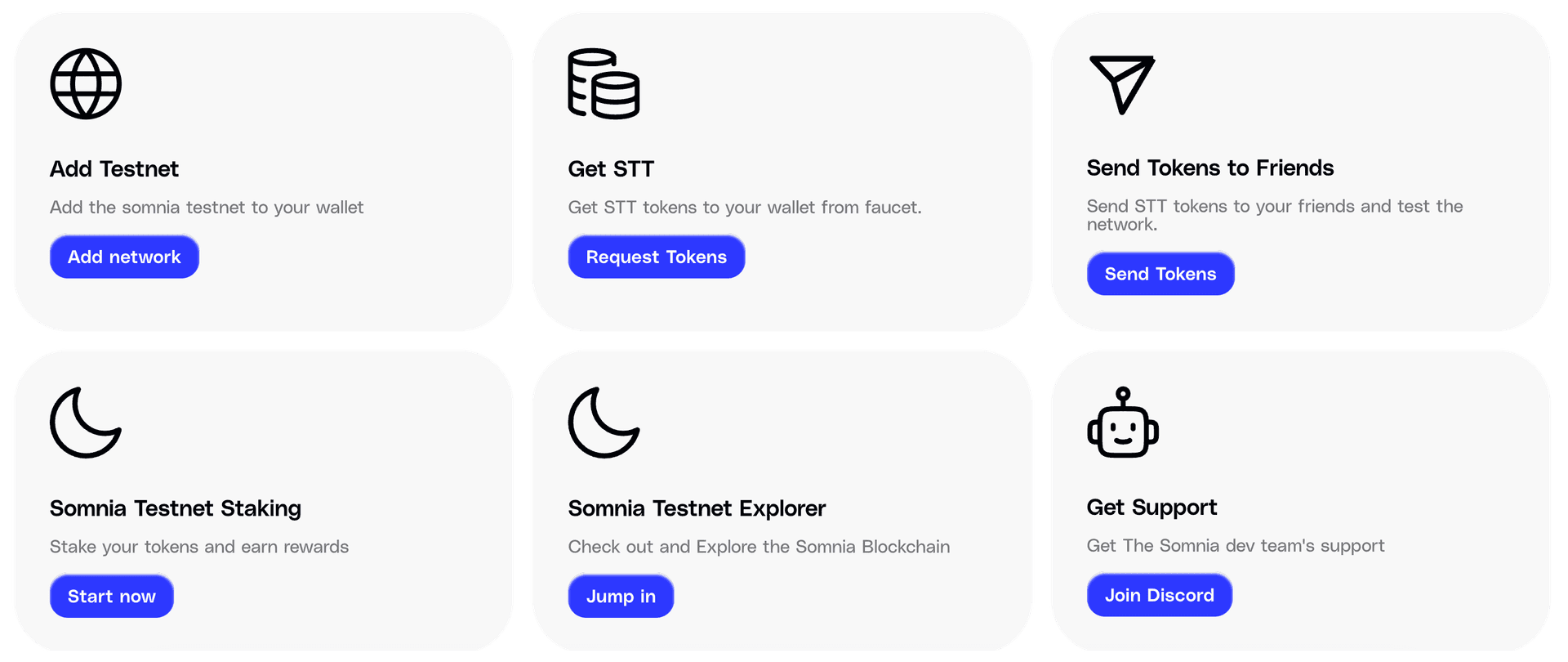
Additionally, official materials also mention options via Discord (a developer channel) and a faucet. Sometimes Google Cloud Web3 faucet is also listed as one of the options - https://cloud.google.com/application/web3/faucet/somnia/shannon
Why Somnia is worth watching right now
Somnia focuses on a clear and convenient user experience-closer to how games and familiar online services work. The project bets on speed and the ability to handle a large number of actions, which is especially important for interactive worlds where everything must happen without delays.
Somnia is also already live on mainnet, meaning the project is in a real operating phase, not just in testing. It also helps that the ecosystem has declared support, which can bring more teams, applications, and content around the network.
And most importantly, interest in metaverses hasn’t disappeared. Over time, expectations simply became more mature: people now care less about pretty promises and more about projects that actually work and provide clear value.
Interesting facts about Somnia Network
Somnia’s test network is called Shannon-an reference to Claude Shannon, one of the key figures in the history of information theory. The name fits the project theme, where speed, data, and interactions matter.
Somnia also openly talks about its focus on real-time applications. For Layer 1 blockchains, this isn’t the most common approach, which is why many people find the network’s progress interesting to watch.
And participation in the ecosystem isn’t limited to developers. You can test apps and worlds, join activities, help the community, and delegate stake if you want to support validators. You can also try the test environment with STT, while others may watch ecosystem metrics and even SOMI price as adoption develops.
Final takeaway
Somnia aims to turn the metaverse idea into a clear, working platform-fast, fee-accessible, and convenient for everyday users. In essence, the project is building a foundation where you can not only do occasional token operations, but also spend time in digital worlds, communicate, create things, and interact with others-while the technology stays unobtrusive and doesn’t distract from the experience.
If you’re curious what the internet could look like next-once there are more interactive worlds and new forms of communication-you can already try Somnia in the testnet and see what projects and activities are emerging in the ecosystem.
Crouton Digital is also participating in the network’s development as one of Somnia’s early validators. We will continue supporting the ecosystem by providing reliable infrastructure on mainnet and testnet and stable node operation.
Frequently Asked Questions

A Web3 OG who has navigated the industry’s evolution from whitepapers to widespread adoption. Having built through the euphoria of bull runs and the discipline of bear winters. Opinions are strictly personal, crafted from years of deep-dive research and hands-on experience in the trenches.