


Arc Network: Circle's Layer‑1 Blockchain and the Economic OS for Stablecoin Finance

What Is the Circle Arc Network and Who Created It?
Arc Network is an open Layer-1 blockchain built by Circle, the company behind the USDC stablecoin. The circle arc network extends Circle's existing infrastructure capabilities — including CCTP and the Circle Payments Network — into the Layer-1 space. Circle is the second-largest stablecoin issuer, with approximately $72 billion of the over $300 billion stablecoin supply. The company introduced Arc on August 12, 2025, positioning it as a network for stablecoin-native settlement.
Arc is not an add-on to another chain — it is a standalone layer 1 blockchain with its own validator set, consensus mechanism, and native gas token (USDC). The circle arc blockchain is positioned as a dedicated settlement layer for institutional stablecoin activity. Circle acquired the Malachite consensus protocol from Informal Systems to form the foundation of Arc's architecture. The acquisition amount was not publicly disclosed.
According to Jeremy Allaire, CEO of Circle, speaking on the Unchained podcast in April 2026, the future ARC token will help provide mechanisms for governance, incentives, economic alignment, and eventually transition the network to proof-of-stake. The token discussion did not occur in August 2025 — at that time, Circle only announced the network itself.
Arc was purpose-built to eliminate the inefficiencies stablecoins encounter on blockchains originally created for general-purpose applications, not for stablecoin-native finance. Traditional blockchains like Ethereum were built for general-purpose applications, not stablecoin finance. This creates problems: unpredictable fees, volatile gas tokens, privacy concerns, siloed liquidity, and complex integration. Arc addresses these challenges with predictable dollar-based fees, sub-second finality, opt-in privacy, and direct integration with Circle's full-stack platform.
Circle describes Arc as the "Economic OS for the internet" — a foundational infrastructure layer for digital money and tokenized value. Arc is designed to serve as the shared infrastructure for onchain lending, capital markets, payments, and agentic commerce at scale. In May 2026, Circle published the official Arc whitepaper, detailing the network's tokenomics, architecture, and governance model.
How Arc Network Works as a Layer 1 Blockchain
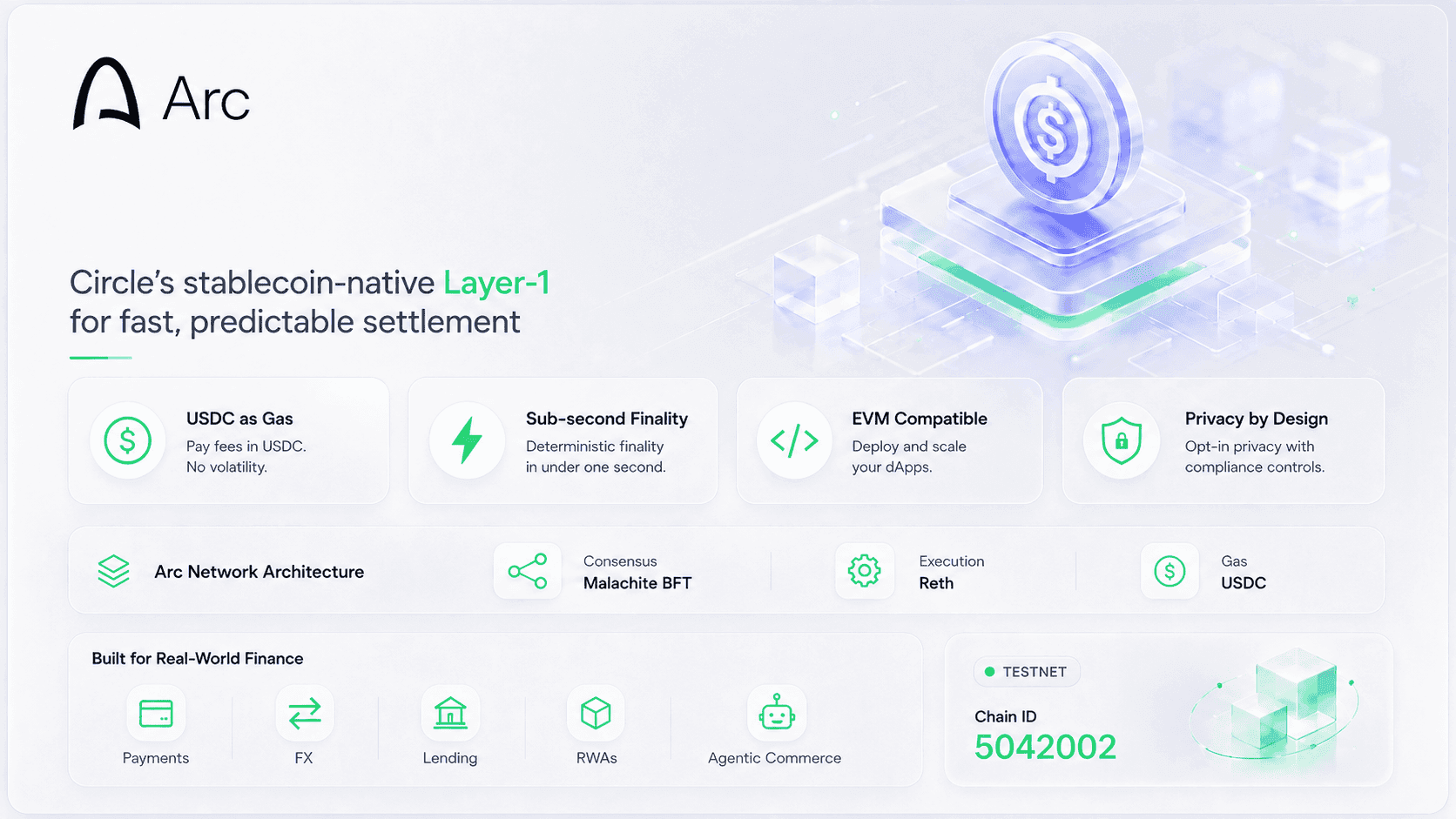
Arc is an EVM-compatible Layer-1 blockchain built on a unique architecture that separates consensus from execution. The network uses Malachite BFT, a Tendermint-based consensus protocol, combined with Reth, a Rust Ethereum client for execution.
Table 1: Arc Network Technical Specifications
| Component | Details |
|---|---|
| Consensus | Malachite BFT (acquired from Informal Systems) |
| Execution | Reth (Rust Ethereum client) — runs the EVM |
| Gas token | USDC (not a volatile native token) |
| Block time | ~0.48 seconds (testnet) |
| Finality | Deterministic, sub-second |
| EVM compatibility | Yes — with some unique differences |
| Chain ID | 5042002 (testnet) |
The most distinctive feature of Arc is that USDC serves as the native gas token. Every transaction fee is paid in USDC, not in a volatile native token. This means transaction costs are predictable and dollar-denominated, no need to hold separate gas tokens, and one USDC balance covers both transfer value and transaction fees.
Arc provides deterministic finality, meaning transactions finalize in under one second with no chain reorganisations. Unlike networks prone to congestion-related delays or reorg risk, Arc's architecture ensures consistent, predictable transaction delivery.
Arc is EVM compatible, meaning Solidity smart contracts can be deployed with minimal changes.
Arc includes a modular privacy system designed to balance compliance with confidentiality. Users and enterprises can selectively shield balances and transactions while staying compliant with regulatory obligations.
Circle also plans to introduce a native ARC token for governance and staking as the network transitions to a more decentralised Proof-of-Stake model. For investors and developers, ARC crypto represents a stablecoin-native blockchain asset to watch as the network evolves.
What Problems Does Arc Network Solve?
Table 2: Problems Arc Solves
| Problem | How Arc Solves It |
|---|---|
| Volatile gas fees | USDC as gas — predictable dollar-denominated fees |
| Slow settlement | Deterministic finality — sub-second |
| No privacy | Opt-in privacy features |
| Siloed liquidity | Built-in FX engine and CCTP bridging |
| Complex onboarding | EVM compatibility — use existing tools |
Arc is purpose-built for stablecoin-native applications: payments with frictionless settlement, foreign exchange through an institutional-grade RFQ system, lending and capital markets protocols, tokenized real-world assets, and agentic commerce where AI agents transact autonomously.
USDC is central to Arc's design. The blockchain uses USDC as its native gas token, and integrates with CCTP for bridging, the Circle Payments Network, and Circle's full-stack platform.
Arc is among a small number of blockchains that use a stablecoin as the primary gas token, positioning it distinctly in the Layer-1 landscape.
How to Test Arc Testnet Blockchain — Guide
Arc's public testnet launched on October 28, 2025, with over 100 institutional participants including BlackRock, Visa, and Goldman Sachs. According to Circle's official mainnet announcement, the Arc testnet had handled approximately 244 million transactions by May 2026, with an average settlement time of just under half a second.
Testnet Parameters (RPC, Chain ID, Faucet)
To connect to the Arc testnet, use the following parameters:
| Parameter | Value |
|---|---|
| Network name | Arc Testnet |
| RPC URL | https://rpc.testnet.arc.io |
| Chain ID | 5042002 |
| Currency symbol | USDC |
| Block explorer | https://testnet.arcscan.app |
| Faucet | https://faucet.circle.com |
Step-by-Step: Connecting Your Arc Testnet Wallet
To use the testnet, add the Arc testnet to your wallet using the details above, claim USDC or EURC test tokens from the faucet, deploy smart contracts or interact with dApps, and view transactions on the block explorer. The arc testnet blockchain is the final testing ground before mainnet launch on September 16, 2026.
How Arc Is Preparing for Mainnet
Arc's mainnet is scheduled to launch on September 16, 2026. At launch, Arc will be secured by 11 founding validators, including:
- BlackRock
- DTCC (Depository Trust & Clearing Corporation)
- Visa
- Mastercard
- Galaxy
- ICE (Intercontinental Exchange)
- MoneyGram
- SBI Group
- Standard Chartered
- Sumitomo Corporation
- Global Payments
(Source: Circle's August 2026 validator announcement.)
The mainnet launch will introduce privacy capabilities, the agent stack for programmable finance, support for tokenized real-world assets, and the full product suite for payments, lending, FX, and capital markets.
Arc operates with a permissioned validator set at launch, transitioning toward more decentralised participation over time. Infrastructure providers — including those running validator nodes and RPC endpoints — play a key role in maintaining network reliability and security for institutional-grade financial transactions.
Why the Web3 Community Should Watch Arc
Arc represents a significant shift in how stablecoin infrastructure is built. Circle raised $222 million for Arc at a $3 billion valuation — a funding round that supports the circle ARC blockchain and was led by BlackRock, a16z, Apollo, and other major financial institutions. Developers can deploy existing Ethereum applications on Arc with minimal changes. Arc is built for agentic commerce as the machine economy grows. With mainnet scheduled for September 16, 2026, the network is moving from testing to production.
Conclusion
Arc Network is Circle's ambitious attempt to build a blockchain specifically for stablecoin finance. By using USDC as native gas, providing deterministic finality, and offering EVM compatibility, Arc addresses real problems that have limited stablecoin adoption on general-purpose blockchains. With $222 million in funding, backing from BlackRock and a16z, and a mainnet launch scheduled for September 16, 2026, Arc is positioning itself as the "Economic OS for the internet", making it a unique layer 1 crypto project focused specifically on stablecoin finance rather than general-purpose smart contracts.
Frequently Asked Questions

A Web3 OG who has navigated the industry’s evolution from whitepapers to widespread adoption. Having built through the euphoria of bull runs and the discipline of bear winters. Opinions are strictly personal, crafted from years of deep-dive research and hands-on experience in the trenches.