


What Is a Blockchain Wallet and How Does It Work?

A blockchain wallet is a digital tool that allows you to store, send, and receive cryptocurrencies. Unlike a bank account, a blockchain wallet doesn't actually store your coins – it stores your private keys, which are cryptographic credentials that prove your ownership of assets on the blockchain. There are many types: custodial vs non-custodial, hot vs cold, mobile, desktop, browser, and hardware. Choosing the best blockchain wallet depends on your needs – daily spending, long-term storage, or dApp interaction. Security is paramount: your private key and seed phrase are the keys to your funds, and losing them means losing access forever.
The Best Blockchain Wallet – Understanding How It Works
A blockchain wallet is a software program or hardware device that stores the cryptographic keys needed to interact with a blockchain network. It doesn't hold physical coins or tokens – it holds the keys that prove your ownership of assets recorded on the blockchain.
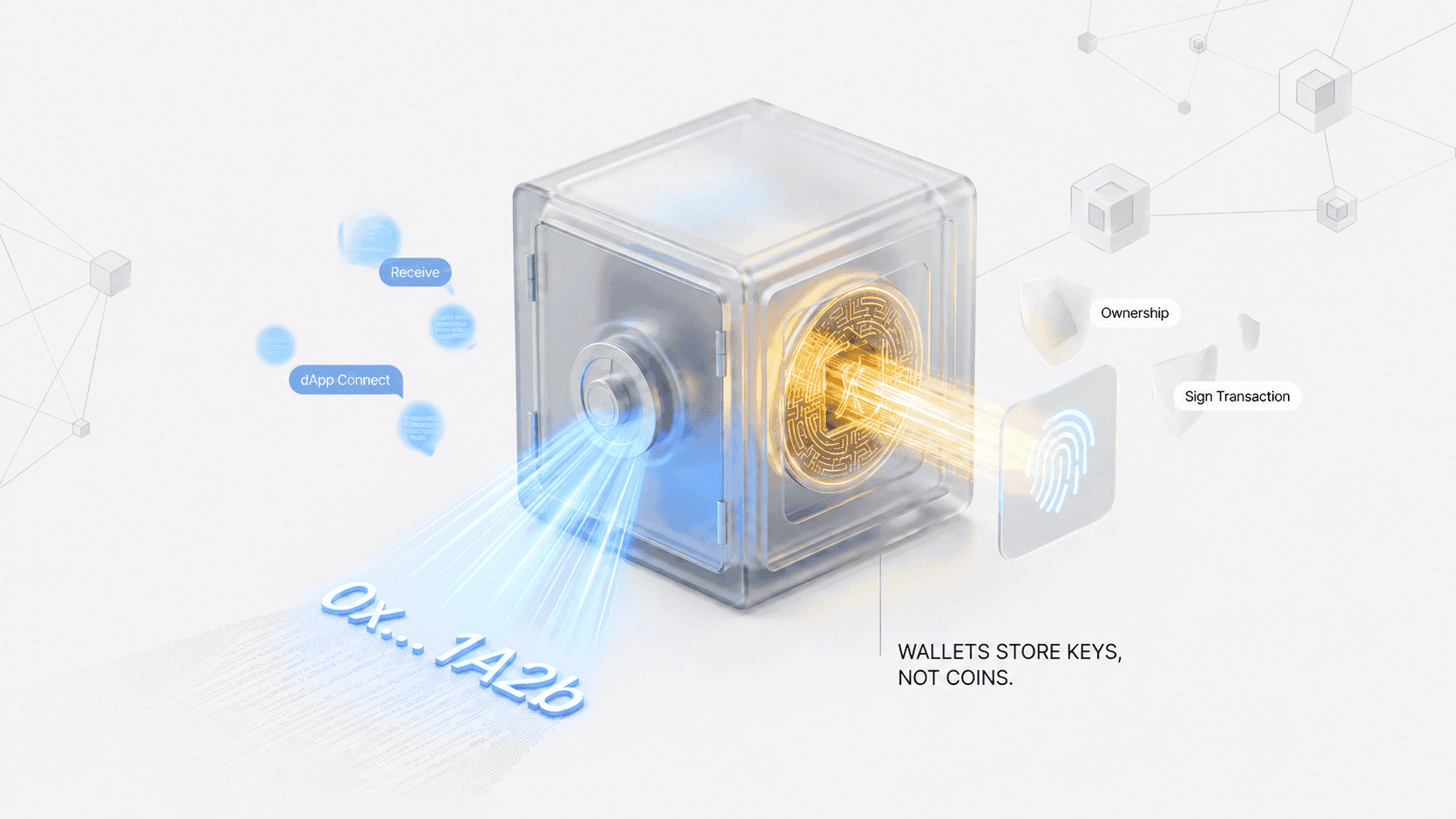
Think of it like a keychain: the blockchain holds the vaults (addresses), and your wallet holds the keys to open them. Without a wallet, you cannot send, receive, or manage your crypto assets.
A blockchain wallet is not a bank account. It is a tool for self-sovereignty – you control the keys, you control the assets.
Private Key, Public Key, and Address – The Core of Crypto Wallets
- Private key: A secret, alphanumeric string that proves ownership of a specific address. It must never be shared. If someone gets your private key, they control your funds.
- Public key: Mathematically derived from the private key via elliptic curve cryptography. It is used to verify signatures but is not the address itself.
- Address: A hashed and shortened version of the public key (e.g., last 20 bytes of Keccak‑256 hash on Ethereum, or Base58Check with checksum on Bitcoin). This is what you share publicly to receive funds. The address is safe to share, while the private key must stay secret.
Warning: Anyone with your seed phrase or private key has full control of your funds. Never share them, store them digitally, or enter them on any website.
Blockchain Wallet Address vs Wallet ID – What's the Difference?
A blockchain wallet address is a unique alphanumeric string (like 0x... for Ethereum) that you share with others to receive funds. It is derived from your public key (via hashing) and is safe to share publicly. In UTXO‑based networks like Bitcoin, you can generate multiple addresses from the same seed phrase for privacy. In EVM‑compatible networks (Ethereum, BSC, Polygon), each account has a single static address; generating a new address typically means creating a new account with its own private key.
A blockchain wallet ID is an internal identifier used by wallet applications to manage user accounts. It is not used for transactions – it is for the app's internal database, like a user ID.
Accessing your wallet: For non-custodial wallets, there is no traditional blockchain wallet login – you unlock the wallet with a password, PIN, or biometrics, and the wallet uses your private key to sign transactions. For custodial wallets (exchanges), a username/password login is used because the provider holds your keys.
Your seed phrase is the master backup. Your app password is just the lock on the app itself – it protects local access, not your keys.
Custodial vs Non-Custodial and Hot vs Cold – Understanding Wallet Types
One of the most important decisions when choosing a blockchain wallet is understanding the different types available.
| Feature | Custodial Wallet | Non-Custodial Wallet | Hot Wallet | Cold Wallet |
|---|---|---|---|---|
| Key control | Third party controls your keys | You control your keys | Internet-connected | Offline |
| Security | Relies on provider | Relies on your practices | Lower (online) | Very high (offline) |
| Convenience | High | Medium | High | Low |
| Best for | Beginners, exchanges | Advanced users, DeFi | Daily use, trading | Long-term storage |
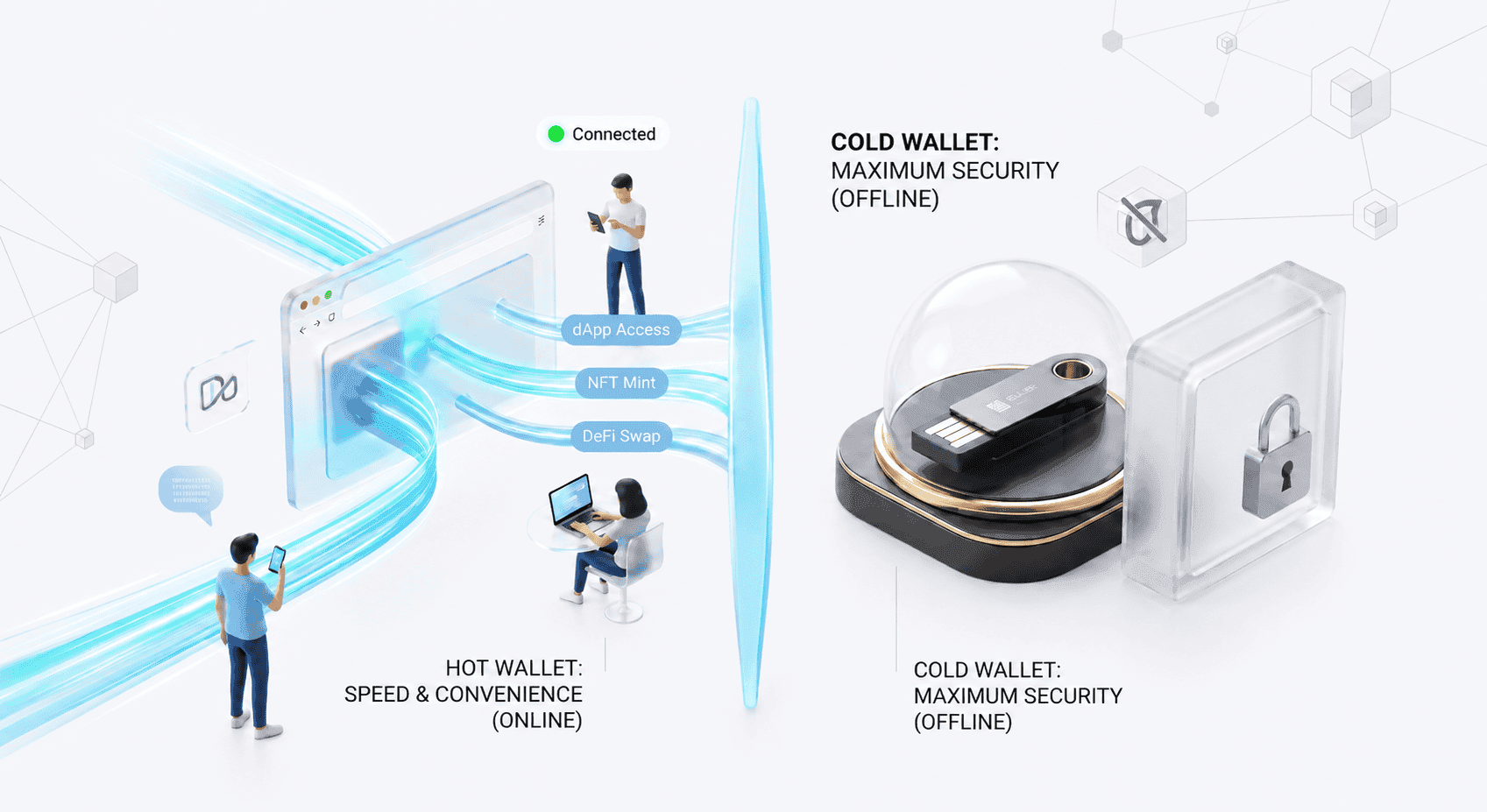
Custodial wallets (e.g., exchanges) hold your keys for you – convenient but require trust. Non-custodial wallets (e.g., MetaMask, Trust Wallet) give you full control but also full responsibility. Hot wallets are connected to the internet – ideal for daily use but more vulnerable. Cold wallets (hardware wallets, paper wallets) are offline – highly secure but less convenient.
Types of Blockchain Wallets – Mobile, Desktop, Browser, and Hardware
There are several types of blockchain wallet implementations, each suited for different use cases. Mobile wallets are apps on your smartphone – for example, Trust Wallet blockchain software company overview shows how a mobile wallet can integrate multiple chains and dApps, while Coinbase Wallet offers a similar experience for beginners. Both are convenient for daily use and QR scanning. Desktop wallets run on your computer (e.g., Exodus, Electrum) – more features but less portable. Browser wallets are extensions like MetaMask and Phantom – essential for interacting with Web3 dApps. Hardware wallets are physical devices (e.g., Ledger, Trezor) – they store keys offline, providing the highest level of security.
A Web3 blockchain wallet is specifically designed to interact with dApps, enabling swapping tokens, minting NFTs, providing liquidity in DeFi, playing blockchain games, and participating in DAOs. A DeFi wallet blockchain is a non-custodial wallet optimised for decentralised finance, with support for multiple chains, native swap and bridge features, and WalletConnect integration.
How to Create, Use, and Manage a Blockchain Wallet
Creating a blockchain wallet is straightforward regardless of the type.
How to create a wallet:
- Choose a wallet type – mobile, desktop, browser, or hardware.
- Download from the official source – never from third-party sites.
- Create a new wallet – generate a seed phrase.
- Write down your seed phrase – store it securely offline.
- Set a password/PIN – for local access.
- Backup your wallet – store the seed phrase in multiple secure locations.
How to send and receive crypto:
- To send: enter the recipient's address, amount, confirm the fee, and sign the transaction.
- To receive: copy your address or share the QR code. In Bitcoin and other UTXO chains, you can generate a fresh address for each transaction; in Ethereum and EVM chains, your address remains the same unless you create a new account.
How to withdraw money from blockchain wallet: send crypto to a centralised exchange, sell it for fiat, and withdraw to your bank account. Some wallets also support in-app fiat off-ramps.
Blockchain wallet fees are separate from wallet service fees. Network fees (gas fees) are paid to miners/validators and are determined by the blockchain protocol, not the wallet. The wallet simply recommends a fee based on current network conditions. Wallet service fees may apply for in-app swaps, fiat on/off ramps, or premium features.
Blockchain Wallet Review – Security, Risks, and Best Practices
Is blockchain wallet safe? The answer depends on the wallet type and how you use it. A blockchain wallet is safe when used correctly, but there are risks:
- Loss of seed phrase – if you lose your seed phrase, you lose access to all addresses derived from it (though a private key for a single address can still grant access to that specific address).
- Phishing – fake websites or apps stealing credentials.
- Malware – keyloggers or clipboard hijackers.
- Fake wallets – malicious apps from unofficial sources.
Security Best Practices and Modern Recovery Options
Never share your private key or seed phrase. Store your seed phrase offline (paper, metal backup). Use hardware wallets for large amounts. Keep your wallet software up to date. Always double-check addresses before sending.
Modern trends: Account Abstraction (ERC‑4337) and Social Recovery are already mainstream. These allow you to set up recovery mechanisms (e.g., trusted contacts, time‑locked recovery) without relying on a single seed phrase. This changes the traditional "one seed, one wallet" model and adds flexibility for users who are not comfortable with manual seed backup.
A blockchain wallet lookup (using a blockchain explorer like Etherscan or Solscan) allows you to view any address's balance and transaction history. This is a public service, not a feature of the wallet app itself.
Blockchain Wallet Development Services – Building a Custom Wallet
Choosing the best blockchain wallet for your project may involve building a custom solution. Custom development services include the design, development, and deployment of crypto wallet applications.
A typical wallet development project involves secure key management, support for multiple blockchains and tokens, transaction history, send/receive functionality, Web3 dApp browser or WalletConnect support, in-app swap and bridge integrations, and fiat on/off ramps. A blockchain wallet API allows Web3 projects to integrate wallet functionality into their platforms – enabling users to connect, sign transactions, and interact with dApps directly.
Blockchain wallet app development requires careful choice of architecture. Non-custodial wallets put users in control but require careful design to avoid key exposure. Custodial wallets give the provider more control but introduce trust risks. Modern approaches like MPC (Multi‑Party Computation) and smart contract wallets (ERC‑4337) offer new ways to balance security and usability.
What to look for when evaluating a development partner: check security audits (who performed them, what was the scope), open‑source status, community support, and integration flexibility. The cost of blockchain wallet app development varies widely – from $15k–$30k for a basic interface to over $500k for a full enterprise solution with MPC, hardware integration, and regulatory compliance. Always request a detailed quote from a blockchain wallet development company with a clear scope of work.
Conclusion
A blockchain wallet is the essential tool for interacting with the world of cryptocurrencies and Web3. It gives you control over your digital assets, enables seamless transactions, and opens the door to decentralised applications. Whether you are a beginner looking for the best blockchain wallet for daily use, or a developer exploring blockchain wallet app development for your project, understanding the basics – private keys, seed phrases, wallet types, and security – is critical.
Remember: choose a wallet that fits your needs, always keep your seed phrase offline and secure, and never share it with anyone. In the world of crypto, you are your own bank.
About This Article
This guide was researched and written by the Crouton Digital team — Web3 infrastructure specialists with practical experience in blockchain networks, RPC services, validators, and wallet integrations.
Transparency Notice
Crouton Digital and its services are referenced where relevant, and we may have a commercial interest in the topics discussed. Third-party wallets, exchanges, protocols, and providers are mentioned for informational purposes only and are not endorsed or guaranteed. Features, fees, supported networks, and security practices may change. Always verify information through official sources and conduct your own research. This content does not constitute financial, legal, security, investment, or technical advice. Cryptocurrency use involves risk, and losing or exposing a private key or seed phrase may result in permanent loss of assets.
Frequently Asked Questions

A Web3 OG who has navigated the industry’s evolution from whitepapers to widespread adoption. Having built through the euphoria of bull runs and the discipline of bear winters. Opinions are strictly personal, crafted from years of deep-dive research and hands-on experience in the trenches.