


Sui Project Review: Ecosystem Analysis, Tokenomics, Asset Price & TVL Overview

What is Sui Coin? Sui Mainnet and Architecture
Sui is an L1 blockchain built from scratch by Mysten Labs (a team of former Meta/Diem engineers) using the Move programming language. Unlike traditional blockchains, Sui represents all data as “objects” (a resource-oriented approach), allowing many independent transactions to be processed in parallel. This enables ultra-low latency and high throughput, improving Sui TPS, Sui transaction speed, and overall scalability. Sui is primarily designed for mass Web3 applications, gaming, and DeFi. The Sui mainnet launched on May 3, 2023.
The network is growing rapidly: as of October 2024, there were more than 85 active projects (DeFi, NFT platforms, Web3 games, and more). Sui actively supports native stablecoins - for example, USDC on Sui by Circle launched on Sui in October 2024 - and is working on its own stablecoins (suiUSDe and USDi planned for 2025).
Sui News and Sui Coin News: Institutional Backing
Sui was developed by Mysten Labs, a startup founded in 2021 by former Meta (Facebook) employees who previously worked on the Diem blockchain project. Founders include Evan Cheng (CEO), Sam Blackshear (CTO), Adeniyi Abiodun (CPO), George Danezis (Chief Scientist), and others - all experienced infrastructure engineers.
Because of this background, Sui has strong technical potential. The team and community place major emphasis on scalability and mass adoption. The object-based architecture and Sui parallel execution model are considered especially promising for games and complex applications.
Sui received significant venture backing early on. Andreessen Horowitz invested $36 million in Mysten Labs (Series A, December 2021). In 2022, the company closed a $300 million Series B round (including $140 million from FTX Ventures) at a valuation of about $2 billion. A total of $405M has been invested in Sui by Coinbase Ventures, a16z, FTX Ventures, YZI Labs, Circle Ventures, Jump Crypto, Hack VC, and others.
Sui Price Today and Strategic Roadmap
Sui’s roadmap includes several major upgrades:
- A trusted cross-chain connection between Sui and Ethereum (announced for Q3 2025)
- SuiNS (move naming service) expected by 2026.
- AI integrations (decentralized automation framework).
- Expansion of DeFi infrastructure including on-chain trading platforms.
Collaboration with TBook will introduce “StableFi”, allowing stablecoins and tokenized RWAs to be distributed as rewards for on-chain participation.
Sui Token Price and Sui Token Unlock Schedule
SUI - The native token. Total supply: 10B.
- 50% - Community Reserve (grants, ecosystem development, validator subsidies)
- 20% - Early contributors
- 14% - Investors
- 10% - Mysten Labs treasury/team
- 6% - Early testers & Community Access Program
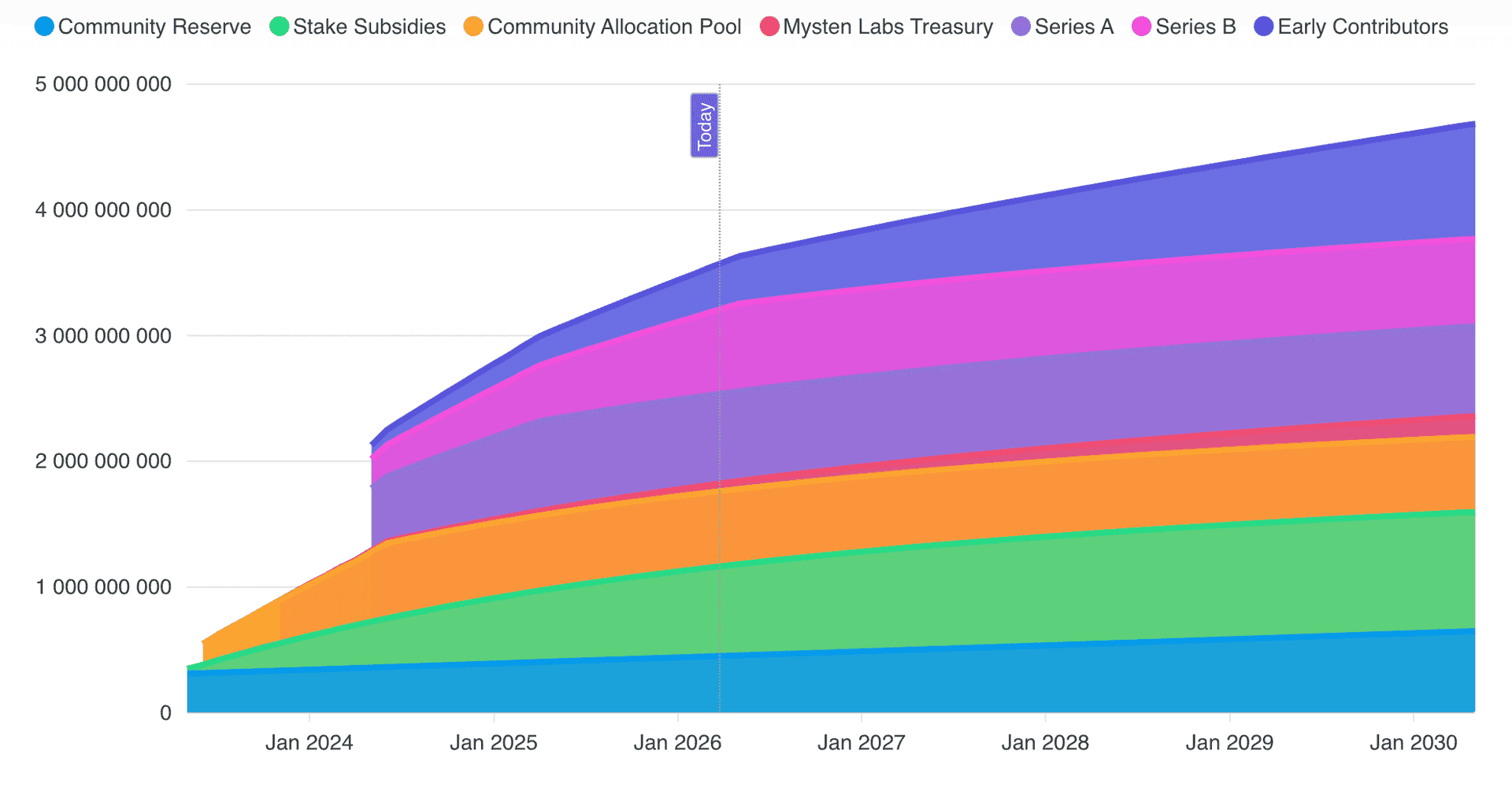
A one-year cliff applied until May 2024, meaning less than 30% of the supply was initially circulating. Over 50% remains locked long-term (some until 2030).
The Sui token unlock schedule is a critical factor that may influence Sui price and Sui price today during large unlock events.
SUI is used for gas fees (Sui transaction fee), staking (DPoS), and network security. There was no public airdrop at launch, as the team aimed to avoid speculation and regulatory complexity.
- Main risk: potential volatility during large unlock events.
- Strength: strong long-term lock structure supporting stability.
Sui Wallet and Network Infrastructure
Sui stands out due to its object-based architecture. Simple object transfers can be processed without global consensus, enabling Sui parallel execution, higher Sui TPS, and lower Sui transaction fee costs.
Key features:
- Narwhal/Tusk consensus (low latency)
- Local fee markets
- Sui Move (modified Move optimized for NFTs and gaming)
- High security (type-safe language)
Closest comparable project: Aptos (also Move-based), but Sui emphasizes object parallelization and low fees more aggressively.
Long-Term Outlook: Sui Price Prediction 2026 and Sui Price Prediction 2030
Sui supports stablecoins on Sui, including USDC on Sui, and has rolled out additional stablecoin initiatives, including ecosystem-specific assets that expanded through 2025 and into 2026 (suiUSDe / USDi). Evolving regulatory landscapes (e.g., U.S. stablecoin frameworks) continue to shape stablecoin issuance on Sui.
Real-world asset (RWA) tokenization is growing via projects like TBook, which distribute tokenized assets as ecosystem incentives.
Sui is positioning itself as a coordination layer for capital, institutional liquidity, and tokenized real-world assets within Web3 financial infrastructure.
Key integrations include:
- Circle (USDC issuance)
- Axelar and Wormhole bridges
- Stork oracle
- Team Liquid (gaming partnerships)
- Oracle Red Bull Racing (NFT collaboration)
- Walrus (data oracle)
- DeepBook (liquidity layer supporting Sui DeFi)
- BTCfi, Seal (encryption tools)
Regulatory compliance remains important, particularly for stablecoins and RWAs.
Core Performance Metrics: Sui Price and Network Activity
Sui ran an incentivized testnet before Sui mainnet launch.
Ongoing programs include:
- Ambassador program (launched Feb 2024)
- Gamified NFT quests (Bullshark Quests)
- Hackathons (Sui Warp, Overflow 2025)
- HydraPower accelerator
- Developer grants (up to $500K)
- Soulbound tokens (SBT) via TBook
Community members contribute via documentation, localization, tutorials, and testing.

Competitive Landscape: Sui Coin Market Cap vs Other L1 Blockchains
Sui is most often compared to Aptos. Both are Move-based and created by former Diem engineers.
Differences:
- Sui uses object-based parallel execution.
- Aptos follows more traditional sequential execution.
Compared to Ethereum, BNB Chain, Solana, etc., Sui is a newer experimental L1 with a unique architecture but a smaller sui market cap.
Strengths:
- Advanced technology
- Strong founding team
- Major investors
- Growing ecosystem
Risks:
- Highly competitive L1 market
- Uncertain mass adoption
- Regulatory exposure for stablecoins/RWAs
Core Performance Metrics: Sui TVL, Sui Price and Network Activity
Core Performance Metrics
- Daily transactions
- Unique active addresses (MAU)
- Total Value Locked (TVL), which has surpassed the $1B milestone and continues to fluctuate with market conditions
- Stablecoin supply on the network (including USDC on Sui and other stable assets)
- Network revenue (daily fees reflecting on-chain activity and demand)
- Validator count and decentralization metrics
These indicators reflect real network usage, capital formation, and long-term ecosystem sustainability beyond speculative Sui price prediction narratives.
How to Buy Sui and Long-Term Sui Price Prediction 2026 / 2030
Long-term outlook (1–2 years) appears promising, especially with infrastructure launches and institutional products (e.g., 21Shares, Grayscale exposure). However, sustained adoption metrics must be proven.
Overall, Sui combines strong technology, institutional backing, and expanding financial infrastructure, making it a high-potential L1 blockchain with meaningful long-term prospects. Market participants often analyze Sui price, Sui price today, Sui coin price, Sui token price, Sui price prediction 2026, and Sui price prediction 2030, but long-term sustainability will depend on network growth and capital formation.
Frequently Asked Questions

A Web3 OG who has navigated the industry’s evolution from whitepapers to widespread adoption. Having built through the euphoria of bull runs and the discipline of bear winters. Opinions are strictly personal, crafted from years of deep-dive research and hands-on experience in the trenches.