


Blockchain Node Deployment in 5 Minutes - Crouton NodeLabs

Crouton NodeLabs is a managed deployment platform for blockchain infrastructure, built by Crouton Digital. It provisions a server, deploys the workload — a validator, an RPC node, a DePIN agent, a game server — and hands the customer a running instance with metrics, logs and command access through an API. Crouton Digital operates the hardware; the customer owns the instance. The catalog covers 14 project types across multiple networks.
The platform did not start as a product. It started as the tooling behind our own validator operations.
Operated First, Codified Second
Crouton Digital has been running blockchain infrastructure since 2023. Our validator practice covers 40 deployments across 31 networks — Cosmos Hub, Osmosis, Celestia, Akash and others — with signing keys held in an isolated segment and automatic failover between signers.
What a team learns from that kind of workload is unglamorous and specific: which chains understate their disk requirements, which binaries need a pinned toolchain version, which p2p ports collide with something else on a shared host, how a snapshot restore fails at 3 a.m. and what that looks like in the logs. Over three years that knowledge stopped living in people's heads and moved into an Ansible repository.
NodeLabs is that repository, productized. This is the part that cannot be reproduced by writing a landing page: it is not a generic deployment tool that added blockchain support, it is a blockchain operator's own toolchain opened up to customers.
Who It Is For
Protocol teams at launch. A new network needs validators and public RPC before it has a DevOps team. NodeLabs supplies both without the protocol hiring for it.
Staking providers expanding coverage. Adding the tenth network to a validator business usually means adding headcount. Here it means adding a configuration file.
dApp teams that have outgrown shared endpoints. Public RPC is rate-limited and shared with whoever else is hammering it that day. A dedicated node with known limits and its own metrics is a different reliability class.
DePIN operators running fleets. Dozens of identical agents across providers and regions, deployed and updated from one description rather than by hand.
One File per Network — the Actual File
The claim we make most often is that adding a network costs one configuration file, not a development project. So here is one. This is the Aztec sequencer definition from our repository, trimmed to the essentials:
# group_vars/aztec.yml

project_name: aztec
network: mainnet
project_version_tag: 4.x

ports:
  p2p:
    public_port: 40400
    container_port: 40400
    port_type: udp
    port_access: public
  admin:
    public_port: 2xxxx
    container_port: 8080
    port_type: tcp
    port_access: private
  api:
    public_port: 2xxxx
    container_port: 8081
    port_type: tcp
    port_access: private

container:
  aztec-sequencer:
    image: aztecprotocol/aztec
    tag: "{{ project_version_tag }}"
    restart: always
    pull_policy: always
    entrypoint:
      - node
      - /usr/src/yarn-project/aztec/dest/bin/index.js
      - start
      - "--node"
      - "--archiver"
      - "--sequencer"
      - "--network"
      - "{{ network }}"
    limits:
      cpu: "{{ project_cpu_core }}"
      memory: "{{ project_memory }}gb"
    volumes:
      - { volume_name: "aztec_data", container_path: "/var/lib/data" }
      - { volume_name: "aztec_keystore", container_path: "/var/lib/keystore" }

volumes:
  aztec_data:
    server_path: "{{ volume_path }}/volumes/aztec_data"
  aztec_keystore:
    server_path: "{{ volume_path }}/volumes/aztec_keystore"
Two things are worth noticing about what is not in this file.
There is no infrastructure code. No firewall rules, no monitoring configuration, no volume provisioning, no service supervision, no reverse proxy. Those live in shared roles that every project inherits. The per-network file declares only what is genuinely network-specific: image, version, entrypoint flags, ports, volumes, resource envelope.
The ports declare intent, not implementation. Each port carries a port_access value of public or private, and the platform turns that into host firewall rules. A p2p port is reachable from the internet; an admin API port is not. That decision is one word in a YAML file rather than a hand-written rule someone has to remember to review — which is the difference between a policy you can audit by reading and a policy you audit by hoping.
The same structure scales to harder targets. Our Ethereum RPC definition uses the identical file shape to describe three coordinated services — a Geth execution client, a Prysm beacon node and MEV-Boost — sharing a JWT secret through a named volume, with per-container resource limits and relay lists inline. It is a longer file. It is not a different kind of file. And it is what the Aztec sequencer above consumes: our own execution and consensus endpoints, not a third-party RPC provider.
For contrast: deploying a node of this class by hand takes a competent engineer roughly two hours. We timed the same work through NodeLabs end to end — registration, server selection, deployment, running sequencer — on the Aztec configuration above. About five minutes. Chain synchronization is separate and depends on the network.
What "With Monitoring" Actually Means
Every host gets the same observability stack, deployed by the same mechanism as everything else:
- node-exporter — host metrics: CPU, memory, disk, network.
- cAdvisor — per-container metrics: CPU and memory utilization, network throughput, uptime, mapped to the specific service.
- smartctl-exporter — SMART disk health, on dedicated hosts.
- vmagent — scrapes all of the above locally on a 10-second interval and remote-writes to a central VictoriaMetrics instance.
The platform reads from that same VictoriaMetrics and surfaces the results in the instance view: resource usage, network throughput, and container liveness derived from last-seen timestamps. Customers see their own instance's metrics in the interface without standing up Grafana or learning PromQL.
Who Operates the Node, and Who Holds the Keys
This question determines what NodeLabs actually is, so we will answer it plainly: NodeLabs is managed node hosting, not a self-hosted tool you install on your own machines.
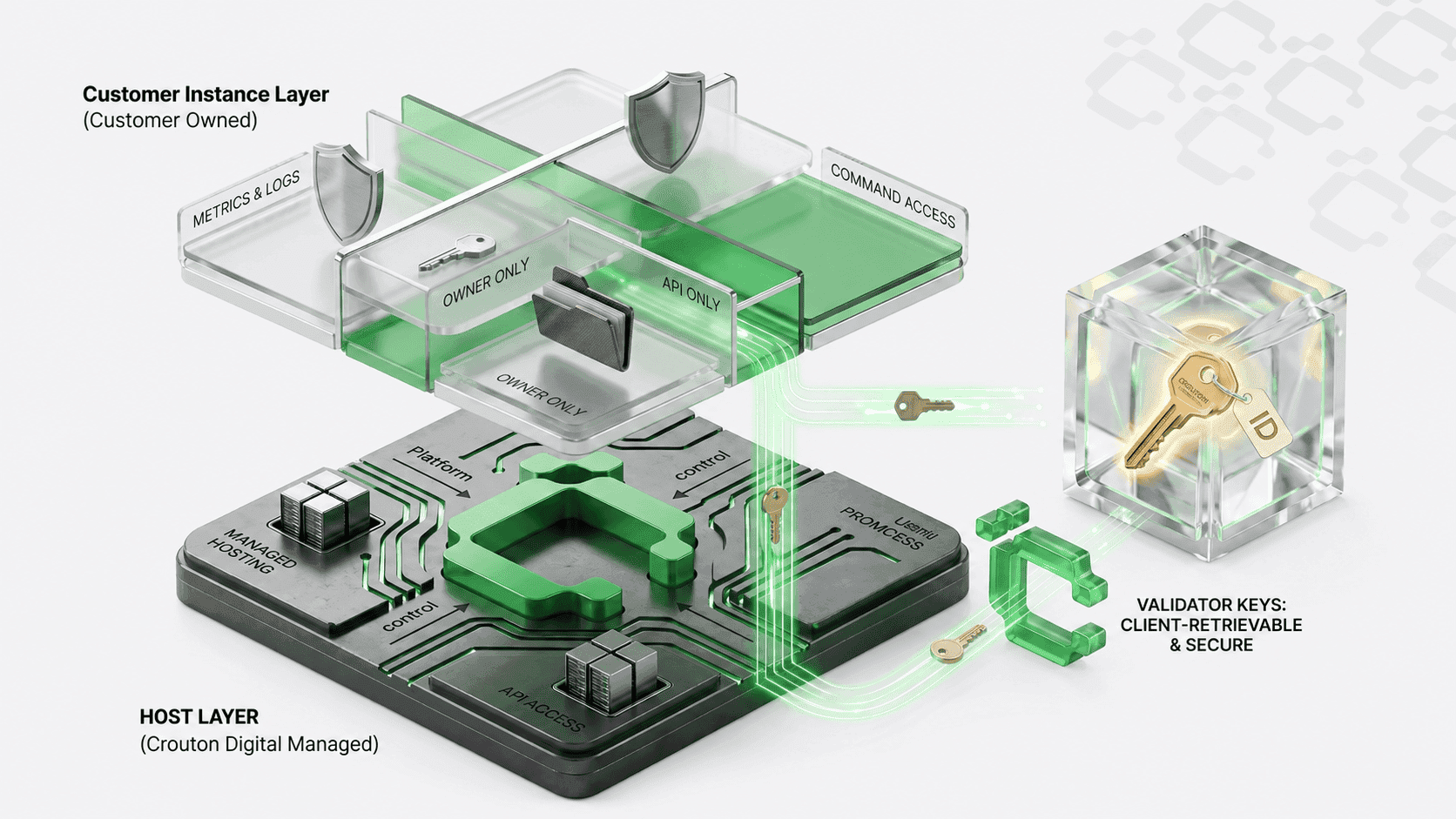
The host layer is ours. Customers do not receive SSH or root access to the server. Commands intended for the container are issued through the platform API, which executes them against that instance and returns the output.
The instance layer is the customer's. An instance is bound to an account. Only its owner can read its logs, see its metrics, issue commands to it and download its artifacts.
Keys. Where a network requires generated validator keys, they are created on the server during deployment, encrypted at rest, and retrievable only by the owning account over authenticated requests. If you are running a security review, we will walk you through the key handling model in detail — generation, storage, access control and retention — under the same terms as any other infrastructure vendor. Ask us before deployment rather than after.
Delivery Layer
The platform's user-facing surfaces run on Cloudflare. In 2026 we received a $10,000 grant through Cloudflare's startup program and put all of it into this layer. Five frontends are now deployed on Cloudflare Pages: the NodeLabs customer interface at nodelabs.crouton.digital, an internal admin interface, our block explorer at explorer.crouton.digital, and staking interfaces for mainnet at staking.crouton.digital and for the Celestia testnet.
Build and publish are triggered automatically on every repository change, and DNS zones are described in Terraform alongside the rest of our infrastructure. The grant covered a bounded, specific piece of work — that is the whole of its role here.
What Is Next
The immediate roadmap is catalog expansion beyond Cosmos SDK and EVM chains: Solana, Polygon, Avalanche and others. The architecture is ready for it for the reason described above — a new network is a configuration file, not a development cycle.
Alongside that, we continue to develop the block explorer and the staking interfaces as products in their own right.
If you are evaluating where to run a node and would rather discuss specifics than a pitch, tell us the network and what you need it to do.
About Crouton Digital
Crouton Digital is a blockchain infrastructure operator founded in 2023, running 40 validator and RPC deployments across 31 networks. Crouton NodeLabs is its managed node deployment platform. Company infrastructure is defined as code end to end, changes go through git, and Crouton Digital is currently undergoing an ISO 27001 audit. Not affiliated with any other company operating under the name Node Labs or NodeLabs.

A Web3 OG who has navigated the industry’s evolution from whitepapers to widespread adoption. Having built through the euphoria of bull runs and the discipline of bear winters. Opinions are strictly personal, crafted from years of deep-dive research and hands-on experience in the trenches.